WE SUGGEST THAT YOU STUDY THE TOP TEN CPO TIPS for buying a Certified Pre-Owned Porsche below. These top ten CPO tips are intended to steer you in the right direction when considering a CPO Porsche.
Not heeding them could mean the difference between getting a deal of a lifetime — or getting burned big-time, even if (or maybe especially if) you end up purchasing a non-CPO Porsche.
Be sure to share any of your own CPO tips, experiences and input in the Comments section below to give a hand up to all of your fellow Porschephiles.
StuttgartDNA Tip:
Looking To Buy a Porsche Certified Pre-Owned (CPO) Late-Model 991.2-gen Porsche 911?
Achtung, baby. First check out our 991.2-gen Porsche 911 Buyer Guide before you make another move. Get to know the broad strokes as well as the intimate minutia of the 991.2-gen Porsche 911 before flocking to your local Porsche-authorized dealerships.
. . . Oh, and you can thank us later while you’re whooshing down the road savoring miles and miles of smiles in your newly purchased CPO 991.2-gen Porsche 911. . .
Top Ten CPO Porsche Tips
Once you narrow down your choice (or choices) of CPO Porsches that you desire, do “all of the below”:
1. Take that all-important test drive
That first test drive is a must. It’s the only way you’re going to know if the vehicle under consideration is the right fit for you. Drive that ride as long as your sales consultant will allow. Also, drive under as many different road conditions and speeds as possible — especially around some tasty twisties, if there are any in your test-drive area.
2. Examine the vehicle’s Porsche Approved Certified Pre-Owned 111-Point Checklist
Determine if the dealership is willing to let you study the official 111-point checklist in question (see two blank forms of the Checklist below) on the vehicle that you are interested in buying. Go over it carefully to make sure there aren’t any oddities or discrepancies.
You may find that the dealer is reluctant – or even completely unwilling — to let you see the official 111-point checklist. RED-FLAG ALERT! Move on to the next dealership and vehicles to consider — as fast as you can. Truly reputable dealers should have absolutely nothing to hide. A good starting point, as such, is first searching for CPO Porsches at Porsche Premier Dealers near you, if any, and then checking all other Porsche Dealers near you.
Porsche CPO 111-Point Checklist, Page 1 of 2. Source: PCNA
Porsche CPO 111-Point Checklist, Page 2 of 2. Source: PCNA
Obtain the documentation of the remaining terms that are left on the new-car warranty, if there is one still in force. Be sure to determine the exact expiration date of that document. This is your base-line starting point of your warranty.
4. Check out the vehicle’s maintenance history
Take a hard look at the maintenance history of the vehicle that Porsche has documented and tracked up through to the time when the previous owner has surrendered the vehicle.
Related Links to Listings in the Porsche Resources Directory to Assist You in Your Car Search:
5. Examine the Porsche Approved CPO Warranty in detail
Be sure to scrutinize the Porsche Approved CPO Warranty’s fine print. This way, you’ll know exactly what you’re getting in to. Then you won’t suffer any blindside surprises down the road.
Credit: Porsche AG
6. Make sure you’re getting a Porsche Factory-authorized CPO Warranty
This may be belaboring the obvious, but determine that the CPO Warranty is definitely backed and sanctioned by the Porsche Factory. Confirm this in writing with your salesperson, who incidentally should be a Porsche Certified Sales Consultant at a genuine Porsche Center dealership in the first place.
This is the only way that you’ll be guaranteed that your warranty will be honored across North America, or across the greater region where you live.
7. Establish the end date of your CPO Warranty
It is imperative that you establish the exact end date of your prospective CPO Warranty — and get it in writing. The complicated calculations of warranty dates and duration of the Porsche Warranty make this critical.
StuttgartDNA Tip:
Get the right car insurance
Before buying that Porsche of your choice, make sure to do your homework on getting the best car insurance for it — read our article on the subject by clicking on the following link:
8. Get that indispensable pre-purchase inspection (PPI)
By all means, it is crucial that you run a pre-purchase inspection on the prospective vehicle. Some if not most dealerships will resist this, but do your best to fight for this critical inspection. As a starting point, check out our Porsche Resources Directory for PPI shops near you; use the Search Filters on that initial landing page to zero in on your State or Province.
9. Bone up on your desired vehicle’s resale value
You need to do your homework before sitting down at the bargaining table. Be sure to research resale values. You should do this anyway whenever you’re in the market for any vehicle, CPO or not. This will put you in a much more powerful bargaining position when the time comes to haggle.
10. Haggle, haggle, haggle away
Did someone say “haggle”? Yes, indeed. You definitely need to negotiate with your Porsche Certified Sales Consultant in order to get the best price possible. You need to negotiate despite the fact that you’re in the market for a CPO vehicle — or, more important, exactly because you’re in the hunt for a CPO vehicle.
After all, you do want to whittle down — as much as possible — that premium factored into the price of a CPO Porsche, don’t you? Of course you do! (See my article entitled Porsche Certified Pre-Owned (CPO) Program for more information on this “premium.”)
Now go get that Porsche of your dreams — or at least one of them for now!
In the “LEAVE A REPLY” space at the bottom of this page, please post your COMMENTS now about this article, your best CPO tips, suggestions, and experiences.
Let us know your impressions, your experiences in searching for a Porsche to purchase and perhaps any experiences — very satisfying through to horrendous — in finding and buying that Porsche.
Start a conversation now, or join in on an existing conversation, by leaving a reply. Your input is highly valued by us and much appreciated!
Selective Suggested Reading for Further Porsche CPO Study
Buying a CPO Porsche – Tricky Warrantee — “horror story” by laphroaig99 posted on the eBay.com website — WEBPAGE TAKEN DOWN FROM eBAY WEBSITE.
CPO or No? — unattributed article in the “Porsche Buyer’s Guide” of the 2015-2016 edition from Excellence magazine
In the Know About CPOs — article by Peter Bohr from Westways, the official magazine of the Southern California AAA Auto Club — WEBPAGE TAKEN DOWN FROM AAA AUTO CLUB WEBSITE.
Most automotive-industry pundits agree on only one thing when it comes to any automaker’s certified pre-owned (CPO) program: All agree that a used but certified pre-owned (CPO) vehicle is going to cost you big bucks, relatively speaking, of course.
This is as opposed to buying a used car from a private party, or a used car that isn’t presented as “certified” from an independent retailer.
On the other hand, what the pundits hardly ever agree on is whether these programs are worth that extra cost, or not.
This is where you come in to the picture: Here’s your chance to arrive at a solution to this dilemma for yourself if you are considering the Porsche Certified Pre-Owned (CPO) Program. Hopefully this article will help you do just that.
StuttgartDNA Tip:
Looking To Buy a Porsche Certified Pre-Owned (CPO) Late-Model 991.2-gen Porsche 911?
Achtung, baby. First check out our 991.2-gen Porsche 911 Buyer Guide before you make another move. Get to know the broad strokes as well as the intimate minutia of the 991.2-gen Porsche 911 before flocking to your local Porsche-authorized dealerships.
. . . Oh, and you can thank us later while you’re whooshing down the road savoring miles and miles of smiles in your newly purchased CPO 991.2-gen Porsche 911. . .
Most important (and probably why you now find yourself on our Porsche-centric website in the first place), the question at hand before us is, “How does the Porsche Certified Pre-Owned (CPO) Program rate?” Or does it?
But, first, let’s begin with a little basic background on the subject in general. . .
Introduction to the Basic Concept of All Certified Pre-Owned (CPO) Programs
The essence of the basic CPO concept boils down to the following two (2) assurances implied by any certified pre-owned (CPO) program:
1. The prospective CPO vehicle has led a relatively charmed life up to now, with the proper scheduled maintenance and servicing, as well as its lack of any major accidents or other evils.
2. A handsome extended warranty will come with the vehicle, thus reassuring the prospective buyer that the dealership will gladly exorcise any and all unforeseen mechanical gremlins from the vehicle in the future.
But here’s the rub when it comes down to the rubber meeting the road:
Industry standards are nonexistent. There is a broad spectrum of CPO program parameters as set by each auto manufacturer. Whereas the Porsche Certified Pre-Owned (CPO) Program requires its vehicles to be eight years old or less in model years, but now with no stated limited miles as in the past, most other programs have much shorter age and mileage criteria, for example.
CPO warranties vary greatly from automaker to automaker. As there are no standards in CPO program parameters, warranties have no uniform coverage criteria. But you can safely assume that you won’t receive the same comprehensive bumper-to-bumper coverage that you would on an original new-car factory warranty.
You will pay a premium for the privilege of buying a Certified Pre-Owned (CPO) vehicle. Depending on the respective automakers’ CPO programs that you are considering, this extra cost varies from a few hundred dollars to perhaps as much as $5,000 or more.
Dealers make the final call on assigning CPO status — not the automaker. Sure, some auto manufacturers prescribe stringent inspection protocols, but they don’t have the final say on CPO qualifying status — the local authorized dealers make that call, sometimes even on vehicles that may actually have failed inspection.
Anyone can “self-certify” one’s own used cars for sale. Beware used-car lots of automaker-unaffiliated, independent resellers. There’s nothing stopping these outfits from creating their own “inspection” programs and deceivingly touting their cars as “certified pre-owned” vehicles.
Scary, huh? No worries. We’re not diehard Porschephiles for nothing, are we? The Porsche brand does possess significant intrinsic value and worth, after all. So, please, do read on. . .
The Porsche Certified Pre-Owned (CPO) Program is viewed as one of the best by automotive-industry pundits and insiders alike.
There are two benchmarks for “Porsche Approved” factory-backed, extended-warranty coverage — cars still under warranty and those no longer under warranty:
Cars under warranty — up to 6 years coverage from the time of used retail delivery
Cars no longer under warranty — the warranty extends to the earlier of 2 years or 50,000 miles from used retail delivery; Porsche’s previous limit of exceeding 100,000 total vehicle miles or more is no longer in effect
In addition, not only is the Warranty completely transferable to future purchasers of the vehicle, but it also carries no deductibles on repair costs.
Finally, roadside assistance is rolled into the package, as is the case for Porsche’s New-Car Warranty.
The Lowdown – Porsche CPO Program Features and Details
Given Porsche’s venerable, stellar standing in the global automotive industry, it stands to reason that the Porsche Certified Pre-Owned (CPO) Program would also yield significant value.
Indeed, the Porsche CPO Program is no exception according to consensus within the industry. It is universally considered one of the best CPO programs in the marketplace.
Vehicles that are first considered for the program are typically trade-ins or lease returns to an authorized Porsche dealership, which slates such vehicles for resell.
The ones that make the cut to enter the Porsche Certified Pre-Owned (CPO) Program are known as “Porsche Approved” vehicles. This appellation is intended to connote the high standards and quality for which the name Porsche stands.
The implication is further bolstered by the fact that all such Porsche Approved vehicles are inspected by, as well as serviced by, Porsche Certified technicians — using only Genuine Porsche parts.
Eligibility for enrollment into the Porsche Certified Pre-Owned (CPO) Program applies to current model-year vehicles, as well as to vehicles up to eight previous model years.
Furthermore, all CPO candidates must pass a rigorous inspection. Factory-trained Porsche technicians run each vehicle through a 111-point mechanical- and visual-inspection checklist (pictured above and below). Most of the checklist’s grades are evaluated on a pass / fail basis.
Any items sustaining a failing grade must be repaired or replaced to factory spec with Genuine Porsche parts. This is the only means by which a vehicle progresses to the next phase.
Thus the dealer not only inspects, but also reconditions, any Porsche Approved vehicle that enters the program.
Question: So, theoretically, any reconditioned Porsche that passes the 111-point test, and that is within the age and mileage windows, automatically makes it into the CPO program, right? Not!
The two major exceptions prohibiting Porsche vehicles from ever entering the Porsche Certified Pre-Owned (CPO) Program are:
Porsches that do not have a full and complete authorized-dealer service history
Porsches that have crash damage, i.e., with four or more repainted panels and/or with evidence of frame repair
The next hurdle is for the dealer to enroll the vehicle into the Porsche Factory CPO Program. The dealer thus incurs a fee of as much as a few thousand dollars for the privilege.
This program entry fee is necessarily passed on to you when you purchase a CPO Porsche. So, again, accordingly, it stands to reason why Porsche Approved CPO vehicles tend to cost as much as they do.
Credit: Porsche AG
The Lowdown – Porsche CPO Warranty Features and Details
The Porsche Approved Certified Limited Warranty itself is considered to be one of the best in the business. As previously mentioned, it carries no deductibles, covering 100% of all approved material and labor costs.
Other research sources, both on and off the Internet, claim that the Warranty is close to a bumper-to-bumper warranty — but be sure to place caveat-emptor emphasis on the words “close to.” After all, most new-car warranties aren’t entirely limitless, all-inclusive “bumper-to-bumper” warranties, either.
As is also the case with most, if not all, vehicle warranties, wear-and-tear issues and expendable items are not covered. The only exception to this rule is if there is a manufacturing and/or material defect in a part, component or mechanism itself. As common sense would tell you, typical wear-and-tear and expendable examples include, but are not limited to:
Cleaning and polishing
Lubricants
Rock chips and scratches in the glass and paint
Spark plugs, filters, brake pads, worn tires, etc., etc.
And be forewarned — your track-day or high-performance driver-education (HPDE) excursions could void your car’s eligibility for the CPO program as well as void your own existing CPO Warranty faster than a Porsche 919 on the Nürburgring’s legendary Nordschleife. Don’t say I didn’t tell you so. . . !
Also bear in mind that the Warranty covers only repairs performed at an authorized Porsche dealer.
Porsche’s roadside-assistance program, simply known as Porsche Assistance, is included under the Warranty. But also be aware of the fact that some costs are associated with this aspect of the program, such as the cost of a new key should you happen to lose yours, for example. Please refer to the Porsche Assistance webpage for all of the details of the program.
As is the case under new-car-warranty coverage, 24/7/365 roadside service is just a phone call away. The Porsche Assistance Program, by the way, is subcontracted to GE Motor Club, which is also the subcontracted factory roadside-assistance provider for Ferrari and BMW, among others.
Finally, because the Warranty is fully transferable to any subsequent owner, have no fear in buying a CPO Porsche from a private owner who may live quite a distance away from you. That’s because Porsche dealerships across North America are bound, by definition, to honor any CPO Warranty.
StuttgartDNA Tip:
Get the right insurance
Before buying that Porsche of your choice, make sure to do your homework on getting the best insurance for it — read our article on the subject by clicking on the following link:
Porsche Certified Pre-Owned (CPO) Program: In Conclusion
In your quest for that special Porsche of your dreams, both CPO vehicles and non-CPO vehicles may pop up on your radar as attractive candidates. It isn’t inconceivable that you could even run across some competing CPO and non-CPO vehicles whose prices vary by only a few hundred dollars or so.
In this scenario — let’s call it Scenario A — you could be running a fool’s errand if to choose the non-CPO vehicle over the Porsche CPO vehicle, in light of all the reasons outlined above in the foregoing narrative.
That’s how invaluable the Porsche Certified Pre-Owned (CPO) Program is when searching for a late-model used Porsche. This is one extreme on the narrow end of the spectrum for the moment. . .
One can find a horror story or two or three or more on the Internet, or such anecdotes by word of mouth, about the Porsche Certified Pre-Owned (CPO) Program.
Among several tales of woe that I ran across on the Net, take, for example, the account about the Porsche factory refusing to cover a blown PCM (i.e., the Porsche Communications Management system, with includes the high-resolution touchscreen and brains of the control center for audio, navigation and communication functions).
Bear in mind, though, that this alleged “horror story” may (or may not) be the result of some protracted dispute over a separate Porsche mentioned in the post, a Cayenne, that was being haggled over by the person posting this story, at this particular dealership. Who can know for sure?
Just because something is splashed across the World Wide Web doesn’t make it gospel, now, does it?
Such negative critiques on the Porsche CPO Program, therefore, have to be taken with a grain of salt: Witness, for instance, restaurant reviews on Yelp which swing wildly from 5-star ratings to 0-star horrendous reviews on any given restaurant.
Have similarly dreadful Yelp reviews about your very favorite eatery ever deterred you from going back to dine there again and again and again? Of course not.
As such, I’m sure that, by now, you’re well aware of the fact that you’re playing the odds here.
Credit: Porsche AG
To pick up the thread from above, take the following Scenario B: On the opposite broad end of the spectrum from the first scenario described previously, you may very well find a used non-CPO Porsche of your heart’s desire for a very attractive rock-bottom price, relative to a moderately higher price tag on a CPO Porsche that also catches your eye.
Such an attractive contender (i.e., the non-CPO Porsche) could possess all of the attributes that you have on your checklist, and more, such as:
The lowest negotiated price
More options
Up-to-date maintenance records
New-car warranty still in effect, etc. etc.
Because you could acquire this Porsche at a steal of a deal, this may be the way to go — or not. Just remember that such a purchase comes with the following caveat in the long term: AS IS — especially if that new-car warranty is about to run out.
The bottom line is this: The Porsche Factory is gambling on the calculated probability that it will spend much less in warranty claims over the long run, relative to its initial outlay in setting up its vehicles in the Porsche CPO program.
Odds are therefore substantially high in your favor with a CPO-purchased vehicle — that is, more than likely, you will be spending boatloads less than what you would normally spend on out-of-warranty repairs on a non-CPO ride.
In the vernacular, that definitely doesn’t suck.
So when you embark upon your quest for a CPO Porsche, use these gathered tips (which are presented here in no particular order) to get yourself the best possible deal with the ultimate goal of increasing your odds that your final deal indeed doesn’t suck:
Test drive the vehicle for as long as the dealership will allow
Do your best to get your hands on Porsche’s 111-point checklist on the car of your choice
Get documentation of the remaining terms of the existing new-car warranty
Try to obtain the vehicle’s maintenance history as performed at Porsche dealerships through and up to the time of vehicle surrender
Study the fine print of the Porsche Approved CPO Warranty so that there are no surprises or misunderstandings regarding your in-depth comprehension of the deal
Be sure to establish and confirm that you will be getting a factory-sanctioned CPO Warranty
It is imperative that you spring for and fight for a pre-purchase inspection (PPI) despite the likely objections of the dealership
Be sure to set the end date in writing of your potential CPO Warranty — this is critical in light of the Porsche Warranty’s complicated calculation of warranty dates and duration
Research resale values as you would when in the market for any other vehicle so that you know, coming in, what your reasonable purchase price will be when haggling
Be sure to haggle with your Porsche Certified sales representative to get the best price possible regardless of the fact that you’re purchasing a CPO vehicle — that is, wheel and deal as you would on any other vehicle to get the best possible price!
Credit: Porsche AG
In the final analysis, bear in mind that, when purchasing a late-model CPO Porsche, you’re acquiring a vehicle with as much as a 6-year / 100,000 mile extended warranty.
Most important, though, is the fact that you’re foregoing most if not all of the cons and any other downside issues associated with buying a brand-spanking-new car. . .
— Wait. Do you grasp the monumental significance of this?! You are thus bypassing one of the largest “hidden” expenses that one incurs immediately upon taking delivery of a new car — the cost of depreciation!
That is, when buying a CPO Porsche, you could be even more than offsetting that front-ended 20% to 30% depreciation cost that any new-car buyer incurs straightaway, depending on what model year you ultimately acquire, of course.
For the new-car buyer, however, the meter on this cost starts running as soon as that new car rolls off the lot, and through the next two to three years of ownership.
But a CPO Porsche can save you almost that entire huge 20-30% depreciation expense instantaneously. Oh, joy!
In the “LEAVE A REPLY” section at the bottom of this page, please post your commentsnow about this article.
Let us know your impressions, your experiences in searching for a Porsche to purchase and perhaps any experiences — very satisfying or horrendous — in finding and buying that Porsche. Your input is highly valued by us and much appreciated!
Start the conversation, or join in on a conversation, now by leaving a reply.
Selective Suggested Reading for Further Porsche CPO Study
Buying a CPO Porsche – Tricky Warrantee — “horror story” by laphroaig99 posted on the eBay.com website — WEBPAGE TAKEN DOWN FROM eBAY WEBSITE.
CPO 101 — unattributed article in the “Porsche Buyer’s Guide” of the 2018-2019 edition from Excellence magazine
In the Know About CPOs — article by Peter Bohr from Westways, the official magazine of the Southern California AAA Auto Club — WEBPAGE TAKEN DOWN FROM AAA AUTO CLUB WEBSITE.
Please share your COMMENTS with everyone by scrolling down to the “LEAVE A REPLY” space below at the very bottom of this page. Your input is highly valued by us and much appreciated!
Porsche AG first-quarter 2021 worldwide sales came back strong to kick off this year.
Deeply rooted in the global Porsche epicenter of Stuttgart-Zuffenhausen, Germany, Porsche AG just reported impressive double-digit growth across the entire globe.
Porsche AG delivered 71,986 cars and SUVs worldwide. This is a bullish increase of just shy of 36 percent, as compared to the same first three months of 2020.
“We are extremely pleased that the community of Porsche customers continues to grow all over the world.”
— Detlev von Platen, Member of the Executive Board for Sales and Marketing at Porsche AG
All Porsche Models Yielded Sizable Sales
As has historically been the case in recent times, Porsche SUV sales outpaced car sales. Porsche AG first-quarter 2021 worldwide sales break out as follows:
Macan — Porsche’s compact but mighty SUV was the demand leader, commanding a whopping 22,458 deliveries
Cayenne — the Stuttgart company’s beefier SUV enticed 19,533 buyers
911 — the company’s iconic flagship sports car is putting miles of smiles on the faces of 9,133 happy drivers
Taycan — Porsche’s very first all-electric sports car in January, February and March 2021 jolted 9,072 customers into partaking of its super-high-torque motors
718 Boxster and 718 Cayman — 6,190 mid-engine roadster and coupé units drove out of showrooms round the world
Panamera — Porsche’s four-door internal-combustion and hybrid automobile trim lines yielded first-quarter sales of 5,600 units
“We are extremely pleased that the community of Porsche Customers continues to grow all over the world.
Established models have supported this excellent result along with the latest additions to our product range, above all the new model variants of the all-electric Taycan.”
Source: Porsche AG
Double-Digit Sales Increases Across the Planet
The members of the Executive Board at Porsche have candidly expressed their pleasure at the worldwide sales increases. In fact, Porsche AG’s double-digit sales growth round the planet is indeed impressive, occurring in all of the following regions:
Europe — +15.5 percent
Germany — +14.3 percent
America — +43.1 percent
USA — +45.4 percent
Asia-Pacific, Africa and Middle East — +45.8 percent
China — +56.0 percent
“Thanks to the great appeal of our brand and a consistent sustainability strategy, we can look back on a very positive start to the year. Order bookings also continue to develop very well. We will fulfill the dreams of many more customers with our sports cars in the coming months.”
Don’t forget to leave a Comment below as well as Like and Share this post. Thanks!
Porsche first-quarter 2021 USA retail sales showed off some nice legs.
Porsche Cars North America (PCNA) revealed that the first three months of 2021 yielded total sales of 17,368 units — up close to a healthy 45 percent compared to the same quarter last year.
Three Consecutive Quarters in the Black
Q1 2021 total quarterly sales were only slightly eclipsed by the 17,560 units delivered last quarter, fourth-quarter 2020. Thus PCNA enjoyed the two best quarter sales ever, back-to-back.
Moreover, Q1 2021 was the third successive positive quarter as demonstrated by year-over-year growth.
“Porsche passion is alive and well in the United States.”
— Kjell Gruner, President and CEO of Porsche Cars North America
Source: Porsche Cars North America
718 Mid-Engines Emerge as Reigning Goliaths
Growth across the 911, 718, Cayenne, Macan and Taycan model lines drove those robust Porsche first-quarter 2021 USA retail sales. Porsche’s iconic 911 earned modest growth of over 7 percent.
The 718 Boxster and 718 Cayman, however, proved themselves to be quite the formidable reigning growth Goliaths in Q1 2021 — nearly tripling deliveries, compared to Q1 2020.
“Porsche passion is alive and well in the United States.
These results are a testament to the drive of our dealers and colleagues, as well as the strongest lineup of cars we’ve ever had — from the 911 to our first electric car, the Taycan. We have ambitious goals for the future and will continue to forge ahead, exceeding expectations along the way.”
Taycan vs. Panamera: No Contest
The new all-electric Taycan model line generated sales of over 2,000 units in Q1 2021. These ample deliveries were second only to those of the Porsche 911. The debut of the rear-wheel drive Taycan contributed substantially to overall Taycan USA sales.
The Panamera trim lines, conversely, epitomized the only disappointment in nationwide deliveries. Panamera sales were down by almost 62 percent.
You may have noticed in the chart above that the Taycan shows an impressively humongous variance of +808.6%.
But don’t be fooled.
This variance is skewed wildly out of proportion because it doesn’t reflect a true comparison to Taycan sales spread across the entire year of 2020. Rather, it is a comparison relative to the Taycan’s debut release and availability very late at the end of 2020.
CPO Sales on the Rise
However, Porsche Approved Certified Pre-Owned (CPO) deliveries in the States exhibited substantial increases. At 7,107 units, Q1 2021 CPO sales rose by 22 percent, relative to the first quarter of 2020.
Don’t forget to leave a Comment as well as Like and Share this post below. Thanks!
2020 Porsche worldwide sales figures showed some legs despite the global plague. Remarkably, just three percent shy of record 2019 sales, Porsche AG delivered 272,162 new cars and SUVs in dreadful 2020 for us all.
“The corona crisis posed a great challenge from spring 2020 onwards,” understated Detlev von Platen, Member of the Executive Board for Sales and Marketing at Porsche AG. “Nevertheless, we were able to keep deliveries comparatively stable for the year as a whole.”
2020 Porsche worldwide sales also comprised the debut into the international marketplace of the highly anticipated Taycan. Porsche’s first all-electric vehicle garnered sales of 20,015 units — in spite of a six-week lockdown that halted production.
The Cayenne even eked out a one-percent increase over last year amid the global chaos. Porsche’s larger SUV muscled through it all with leading sales of 92,860 units.
Porsche’s sports cars also contributed to better-than-expected annual worldwide revenues. Ever the perennial darling, Porsche’s iconic flagship 911 boasted deliveries of 34,328 units. The 718 Boxster and Cayman models garnered sales of 21,784 cars offering miles and miles of fun-filled driving. This represents a six percent increase over deliveries of the previous year.
Source: Porsche AG
As the chart above indicates, Porsche AG earned as-expected substantive sales in China. 88,968 vehicles found their way to Chinese customers — evincing an increase over 2019 of 2.6 percent. That same encompassing region of Asia-Pacific, Africa and the Middle East bolstered these figures, with a similar 4.5 percent increase over last year, at deliveries of 121,641 vehicles.
Porsche recorded sales of 80,892 and 69,629 sports cars and SUVs in Europe and the Americas, respectively.
Please share your COMMENTS with everyone by scrolling down to the “LEAVE A REPLY” space below at the very bottom of this page. Your input is highly valued by us and much appreciated!
2020 Porsche USA sales scored their second-best revenues to date, according to Porsche Cars North America (PCNA). Despite the COVID Pandemic, annual numbers declined only by 6.9 percent, compared to 2019. Nonetheless, 2020 annual figures still exceeded 2018’s sales numbers.
Source: Porsche Cars North America
Fourth-quarter revenue came in at a record 6.4 percent compared to a year ago, with 17,560 deliveries. This was the second consecutive positive quarter, demonstrating the robust ongoing recovery in the wake of the Pandemic.
“Achieving our second-best sales year in the U.S. despite the many challenges of 2020 is a testament to the resilience of Porsche, the dedication of our dealer partners, and the excitement generated by our brand,” asserted Kjell Gruner, President and CEO of PCNA.
“Now we start 2021 with the most diverse and complete range of cars we’ve ever had,” continued Mr. Gruner, “from the groundbreaking Taycan, to the sleek Cayenne Coupe and phenomenal 911 Turbo S. I am optimistic for PCNA and our 192 independently owned and operated U.S. dealers.”
The immortal 911 garnered the highest two-door sports-car deliveries. The Macan and Cayenne characteristically performed strong throughout 2020, as well.
The Taycan, Porsche’s first all-electric model, performed admirably, with 4,414 deliveries across the USA last year — interestingly with close to one-quarter of those sales demanded by California customers.
Porsche Approved Certified Pre-Owned (CPO) sales did well, too. CPO units totaled 27,261 deliveries, up 8.6 percent compared to last year. For example, CPO sales yielded 7,081 units in the fourth quarter.
It has been over 50 years since Porsche seized its first Le Mans 24 Hours overall victory. This is the history of Porsche’s 19 overall wins at 24 Hours of Le Mans.
But even more than a half-century ago, Porsche set the stage for its domination in global motorsport, from those earliest days of Porsche No. 1‘s first win in Innsbruck, Austria, to present day. Although, the first overall huge endurance victory took place much later during the venerable, legendary racing granddaddy of them all, the 24 Hours of Le Mans.
Peering in the rear-view mirror of racing history, we glimpse countless class triumphs and a record 19 overall Le Mans victories for the marque of Porsche ever since that first victory on June 14, 1970.
But Porsche had to crawl before it could walk, and then run the marathon that was and is the 24 Hours of Le Mans. As luck would have it, though, Porsche’s first crack at the 24-hour race at the Circuit de la Sarthe, France, foretold Porsche’s unprecedented triumphs to come.
The year was 1951, and Porsche’s maiden 356 SL entry captured the attention of the racing world with a first-time Le Mans 24 class victory. Going forward, though, was a long row to hoe for the Stuttgart sports-car constructor.
Yes, Porsche kept a low but promising profile winning time to time in its smaller-displacement classes. This restrained underachievement endured through the late 1960s. Yet gradually Porsche began pressing its foot down in earnest on the strategic accelerator of motorsport.
Navigable History of Porsche’s 19 Overall Wins at 24 Hours of Le Mans
You are able to learn more about the history of Porsche’s 19 overall wins at the 24 Hours of Le Mans from start to finish, if you so desire. Or you can utilize the navigable Table of Contents / Outline right below to navigate the whole article to and from the items that you wish to peruse at your own leisure, and skip the items you do not want to read.
Introduction to the History of Porsche’s 19 Overall Wins at 24 Hours of Le Mans
Losing Le Mans in 1969 by only a whisker, the closest photo finish in Le Mans history, turned the tide for Porsche. It demonstrated Porsche’s growing lust to win. And it also demonstrated Porsche’s determined will as well as its honed acumen to win.
In hindsight it is clear to see that Porsche had amassed a substantial body of racecraft knowledge and skillsets from those previous two decades of discreet research and development at the Circuit de la Sarthe.
Yet, equally important — if not more so — were the Le Mans drivers. Porsche’s factory and privateer drivers emerged over the half-century as some of the best in the business — as we will soon discover…
So Begins the History of Porsche’s 19 Overall Victories at 24 Hours of Le Mans in 1970
1970 — Porsche’s 1st Le Mans 24 Win
Porsche’s motorsport reputation grew and grew over the two decades of the Fifties and Sixties. As testament to that fact, 24 of the 51 entries in the 1970 24 Hours of Le Mans were Porsche race cars. Clearly these privateers early on recognized that there was no substitute for a Porsche.
This edition, the 38th running of the 1970 24 Hours of Le Mans Grand Prix of Endurance, occurred on June 13 and 14, 1970. Pouring rain wreaked havoc on the drivers and their race cars during a large portion of the race. As a result, there were accidents galore.
The staggering rate of attrition was such that only seven race cars received classification as finishers. Worst of all, Jackie Ickx (BEL) driving his Ferrari entry somehow crashed in the dark of night. When the dust had settled the discovery came that a track marshal perished during the accident in the Ford Chicane.
Many of the film’s racing sequences originated from the point of view of the competing No. 29 Porsche 908/02 car, powered by a Porsche 3.0-liter flat-six. Officially entered in the race by Mr. McQueen’s Solar Productions, the 908 was rigged pre-race with movie cameras and driven by Herbert Linge (DEU) and Jonathan Williams (GBR).
Also worthy of note is the fact that this 1970 Le Mans 24 marked the first year drivers had to start the race already buckled up in their racecars. Gone was the classic “Le Mans Start” to the races.
Those bygone signature starts entailed the drivers running across the track, jumping into their cars, starting them and accelerating as fast as possible in hopes of gaining some race advantage.
The “Le Mans Start,” incidentally, was the fundamental motivation for Porsche’s decades-old decision to install the car-key’s ignition on the left side of the steering wheel for more efficient race starts. This kept the driver’s right hand free for shifting the car into first gear, in left-side-driven cars.
Porsche’s 1st Le Mans 24 Overall Victory Came Courtesy of Richard Attwood and Hans Hermann’s Brilliant, Flawless Driving
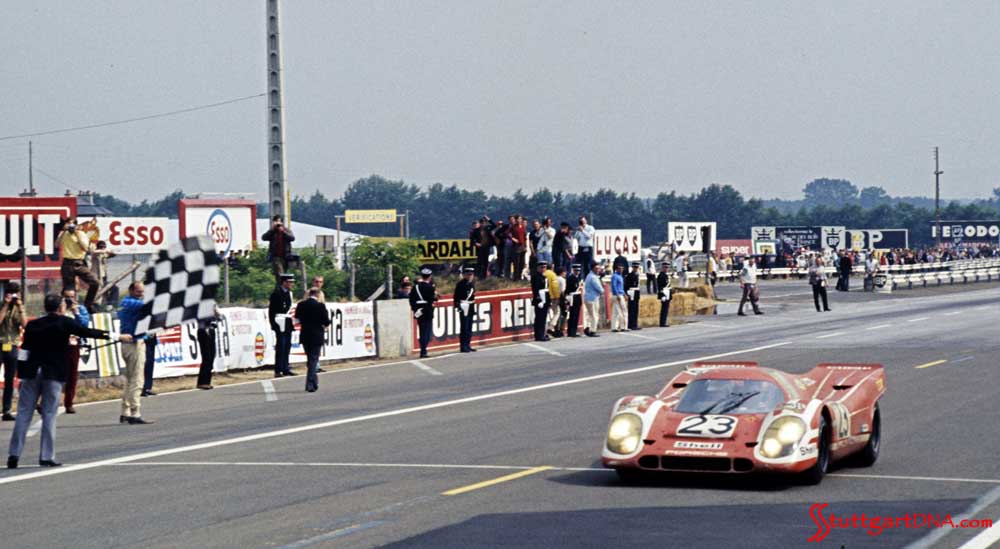
Crossing the finish line in overall first place during the 1970 24 Hours of Le Mans was the No. 23 Porsche 917 K-70, with a Porsche 4.5-liter flat-twelve. Richard “Dickie” Attwood (GBR) and Hans Herrmann (DEU) shared driving duties for the Porsche Salzburg team. They finished an entire five laps ahead of the field.
Fairly recently, Mr. Attwood mused, “The victory gained in significance over the years. Who would have thought that Porsche would become the record title holder at this race?”
As if Porsche’s first overall win wasn’t enough, two other Porsche entries finished right behind the victorious Attwood-and-Hermann Porsche:
Second place snatched by the No. 3 Martini Racing Porsche 917 LH in “mind-blowing” green-and-blue livery — and thus dubbed alternately the “Hippie Car” or “Psychedelic Porsche” — as co-piloted by Willi Kauhsen (DEU) and Gérald Larrousse (FRA) — powered by a Porsche 4.5-liter flat-twelve
Third place taken by the No. 27 Martini Racing Porsche 908/01 LH Spyder of fellow countrymen Rudi Lins (AUT) and Helmut Marko (AUT) — with a Porsche 3.0-liter flat-eight
Thus Porsche stood tall on all three steps of the podium post-race at the 1970 24 Hours of Le Mans.
The second-place and third-place Porsche race cars had very long tails ending in wings, which significantly reduced drag. The race cars came to be famously — and winningly — known as “long tails” or langheck. Hence the racing press nicknamed them the “Batmobiles.”
The 1971 39th running of the 24 Hours of Le Mans and Grand Prix of Endurance proved victorious for Porsche once again. The field contested the race on June 12 and 13, 1971. What a field it was, too. At the start of the race, this time there were 33 Porsche race cars starting among the entire field of 49 entrants.
This year was the first running of the No. 23 Martini Racing team “Pink Pig” Porsche 917/20 as cheeky sequel to last year’s Martini team “Hippy Car” or “Psychedelic Porsche” 917 LH.
A Porsche 4.9-liter flat-twelve propelled the oinker. Reinhold Joest (DEU) and Willi Kauhsen (DEU) rode the buckin’ Pig to an unfortunate DNF because of an accident about 12 hours into the race.
Gijs van Lennep and Helmut Marko Snagged Porsche’s 2nd Le Mans 24 Victory in 1971
The checkered flag dropped on the No. 22 Martini Racing team Porsche 917 K-71 of Gijs van Lennep (NLD) and Helmut Marko (AUT). Following behind them to ascend to the second step of the podium was the No. 19 John Wyer Gulf Racing team Porsche 917 K-71 of Richard Attwood (GBR) and Herbert Muller (CHE).
A Porsche 4.9-liter flat-12 powered both top-podium finishers.
Porsche thus enjoyed its second overall Le Mans victory. The Stuttgart sports-car manufacturer also found great pride in the fact that six Porsche 911 entries found themselves in the dozen of classified finishers.
Porsche’s third overall win came in 1976 during the 44th running of the 24 Hours of Le Mans and Grand Prix of Endurance. That year’s granddaddy of endurance races ran on June 12th and 13th, 1976.
The ruling body of the Le Mans 24 — the Fédération Internationale de l’Automobile (FIA), or the International Automobile Federation — shook things up this year by shuffling the deck of regulations governing the various Group classifications. Among other things, the FIA introduced new Group 5 and Group 6 regulations, as well as opened the race up to nine individual classes.
Porsche was all over this, as the company’s motorsport division was and is so inclined whenever there are significant rule changes. Porsche had new models that it wanted to introduce into the racing world. So the company entered the 934 race car into Group 4, the 935 in Group 5 and the embryonic 936 in Group 6.
Turbocharging was coming of age in the racing world. Porsche was at the forefront to exploit the use of turbochargers. In fact, all told, there were more than a dozen of such forced-induction entries fielded by a number of manufacturers. Seventeen turbocharged racecars made the journey to the Circuit de la Sarthe.
At the time, Porsche utilized state-of-the-art Kühnle, Kopp & Kausch Company turbochargers. Porsche used these turbos in not only in their own works cars, but also supplied Kühnle, Kopp & Kausch-turbocharged engines to its privateering customer teams.
Overseeing the deployment of these turbocharged engines was none other than Porsche engineering mastermind Norbert Singer. Between 1970 and 1998 Mr. Singer played a major role in every one of Porsche’s 16 overall race wins in that exhilarating racing timeframe for Porsche.
Finally, worthy of note is that this Le Mans 24 marks the first time in history that Ferrari didn’t field an entry since 1947, the year of the company’s founding.
Jacky Ickx and Gijs van Lennep Broke on Through to the Other Side to Garner Porsche’s 3rd Le Mans 24 Victory in 1976
Out of Sarthe’s waning pre-dawn inky murk of Sunday morning, the No. 20 Porsche 936-002 and its Porsche 2.1-liter flat-six emerged and careened on and on and continued to perform magnificently.
Conversely, the No. 40 Martini Racing Porsche System works team Porsche 935 struggled to catch up but fate intervened first to cause precipitate an ignition snafu, and then to trigger its Porsche 3.0-liter flat-six turbocharger collapse.
The No. 20 Martini Racing Porsche System factory team Porsche 936-002 Spyder persevered to smirk in the face of ever-threatening attrition in attendance at any 24-hour race. Its Porsche 2.1-liter turbo flat-six propelled the No. 20 Porsche to final victory — winning the 1976 24 Hours of Le Mans overall, Porsche’s third such triumph.
This memorialized for the record books the first turbocharged racer to win at Le Mans. Jacky Ickx (BEL) and Gijs van Lennep (NLD) practically coasted in the 936 turbo to victory.
The No. 20 Porsche 936-002’s win proved rather embarrassing for other manufacturers. That is, the No. 20 Porsche reveled in an insurmountable 11-lap margin when it took the checkers — even in spite of suffering a ruptured exhaust pipe threatening to take out the turbocharger that took over half an hour to repair in the pits on Sunday morning.
Porsche also clinched a class win in Group 5. The No. 40 Martini Racing Porsche System works team Porsche 935 hung in there to snag that Group 5 victory. It also finished with a very respectable fourth position overall.
In 1977, the 45th running of the 24 Hours of Le Mans and Grand Prix of Endurance took place on June 11th and 12th. Porsche entered its 936, hoping to win again this year as it had done in 1976.
Powered by its Porsche Type 935 2.1-liter turbo flat-six, The No. 3 Martini Racing Porsche System factory Porsche 936/77 of Porsche legend Jacky Ickx (BEL) and Le Mans legend Henri Pescarolo (FRA) completely loses it engine early on in the race.
Jürgen Barth, Hurley Haywood and Jacky Ickx Tag-Teamed Their Way to Porsche’s 4th Le Mans 24 Victory in 1977
With nothing else better to do after his engine went kaput, Mr. Ickx switched intramural factory teams. He joined the team of Jürgen Barth (DEU) and Hurley Haywood (USA) in the No. 4 Martini Racing Porsche System factory Porsche 936/77 with the same turbocharged flat-six as the sister car.
Experiencing less-severe mechanical troubles as well, the No. 4 936/77 dropped down in the field like a rock to 42nd place. Somehow all three drivers managed to move back up in the field throughout the rainy, foggy blur of night.
By the end of the race, the No. 4 Martini Racing Porsche System factory Porsche 936/77 had muscled its way to the head of the class to finish first in the 1977 24 Hours of Le Mans.
The amazing thing about the victory was that the No. 4 Porsche 936/77 accomplished this on only five of its six cylinders, coughing up billows of smoke along the way but finishing the race nonetheless.
This was Porsche’s fourth overall Le Mans triumph.
Since the dawning of Porsche’s involvement in motorsports, the marvelous marque from Stuttgart typically pursues a no-nonsense, straight-as-an-arrow approach to racing. Nonetheless the participation of one of Porsche’s privateers in the 1979 24 Hours of Le Mans reeked of notoriety and intrigue.
But we’ll get back to dishin’ that dirt in a moment.
This was the 47th running of the 24 Hours of Le Mans and Grand Prix of Endurance, which unfolded on June 9 and 10, 1979. By this time, the racing-modified versions of the Porsche 911 street-production car — especially the 935 Turbo — started coming into their own battling on racetracks around the world.
The 935’s thoroughbred turbocharged Type 935 3.0-liter flat-six engines certainly didn’t hurt. So it’s no wonder that Porsche’s customer teams bought up the Porsche 935 in droves — and the 935 started winning races in droves too…
“From-Le Mans-to-Ex-Cons” Brothers Whittington Miraculously Scored Porsche’s 5th Le Mans 24 Victory with Klaus Ludwig in 1979
The customer squad in question was the Porsche Kremer Racing Team. The team was led, of course, by Porsche privateering icon Erwin Kremer. Mr. Kremer’s lead driver was Klaus Ludwig (DEU), who did most of the heavy lifting during this 1979 running of Le Mans in the No. 41 911-based Porsche 935 Kremer K3 Turbo 3.0 that year.
Ultimately, the Porsche Kremer Racing privateering team’s No. 41 Porsche 935 K3 won the race with its Porsche Type 935 3.0-liter turbo flat-six engine. Winning with 8 laps ahead of its next competitor, the No. 41 Kremer scored Porsche’s fifth overall Le Mans 24 victory.
Now back to dishin’ it…
In due course it came out in the dirty laundry’s wash much later that the Whittington brothers bought their seats in the No. 41 Porsche 935 Kremer Turbo with ill-gotten funds from drug-smuggling(!) activities. Both brothers ultimately served prison sentences for their illicit activities. Check out the following YouTube video for more dish…
Second place went to another 911-derived race car, Dick Barbour Racing’s No. 70 Porsche 935 Turbo 3.0, driven by Dick Barbour (USA), movie-star Paul Newman (USA) and Rolf Stommelen (DEU).
Another Porsche Kremer Racing entry, the No. 40 Porsche 935 Kremer 77A Turbo 3.0, garnered third place, helmed by Laurent Ferrier (FRA), François Sérvanin (FRA) and François Trisconi (FRA).
Adding insult to injury to the prototypes in the race, this was the first time that a production car-derived race car not only won Le Mans, but swept all three steps on the overall podium.
The first- and third-place finishes of the Kremer Team triggered a deluge of orders for Erwin Kremer’s 935 turbo race cars from privateers around the world, as well.
Porsche’s 1981 through 1987 24 Hours of Le Mans Record-Setting Winning Streak
1981 — Porsche 6th Le Mans 24 Win
The 49th running of the 24 Hours of Le Mans and Grand Prix of Endurance took place on the 13th and 14th of June, 1981. Obviously, no one knew it at the time, but this was the dawning of Porsche’s momentous seven-year winning streak on the hallowed grounds of the Circuit de la Sarthe.
Earlier, Porsche had heard it through the international grapevine of global motorsports that a move was afoot to shake up Le Mans 24 regulations again. Specifically, word got out that the FIA was once again going to introduce a new sports-car category, perhaps as early as the 1982 Le Mans 24.
So, as always, the Stuttgart-Zuffenhausen manufacturer worked on getting out in front of the game. Hence Porsche rushed to develop a new race car to fit as optimally as possible within the new category.
Ultimately, the tentative modifications to the regulations solidified and came into sharper focus: The new category came to be known as Group C, which consolidated the FIA’s Group 6 category and the ACO’s GTP category.
Usually, such changes place emphasis on engine-power limitations — like the International Motor Sports Association (IMSA) in North America shrewdly instituted at this same time instead of adopting the Group C regulations. That is, IMSA limited a race car’s power by focusing on the implementation of inlet air restrictors.
But this was not the case for the regulations of Group C, this time around. Instead, Group C focused on restrictions on fuel consumption. In other words, the goal was to level the playing field for smaller turbocharged engines to compete on “equal footing” with larger, naturally aspirated engines.
In the January 2020 issue (No. 754) of the Porsche Club of America’s Porsche Panorama magazine, Porsche engineer extraordinaire Norbert Singer explained, “The Group C was a formula based purely on consumption. At the beginning, you were allowed 600 liters and five fill-ups for one 1000 km race.”
Mr. Singer should know — he was Porsche’s architect-in-chief of the seemingly invincible 956 and its evolutionary 962 incarnation that dominated Group C for many years.
Enter the new 936/81 race car which Porsche wanted to “test run” in this 1981 race as prelude to hitting the ground running and going balls to the wall in the new Group C designation during its inauguration in the 1982 Le Mans 24.
There was absolutely no time to waste. The last-minute decision to contest that year’s Le Mans 24 was made less than a year before the rapidly looming race to come in June. Basing the 936/81 on the 936 Spyder which won Le Mans in 1976 and 1977, Porsche, needless to say, fast-tracked R&D and final production.
Barely in the nick of time, Porsche fielded two finished 936/81 factory entries without benefit of customary Le Mans pre-testing, which was suddenly cancelled that year. The two factory entries sported a new 4-valve, twin-turbo 2.6-liter flat-six engine boasting unprecedented water-cooled heads.
Lo and behold, both virgin 936/81 entries turned out to be the quickest qualifiers in the field.
Jacky Ickx, Once Again, and Derek Bell Captured Porsche’s 6th Le Mans 24 Victory in 1981
Unknowingly launching Porsche’s seven-year consecutive 24 Hours of Le Mans winning streak, Derek Bell (GBR) and Jacky Ickx (BEL) co-piloted the Porsche System works No. 11 Porsche 936/81 to resounding victory in the 1981 24 Hours of Le Mans with the greatest of ease.
The No. 11, Chassis No. 936-003, held the lead after Hour 1 and never ever looked back. Ickx and Bell’s lead grew by a greater and greater margin to the point where they won the race by 14 laps, almost an hour ahead of its next second-place rival.
This was great news for Ickx, whom Porsche had coaxed out of retirement just for this race to help break in the new 936/81. This made him a five-time winner of the 24 Hours of Le Mans, breaking fellow Belgian Olivier Gendebien’s 1962 record. This was no trifling feat for Ickx, as Gendebien was considered one of the greatest sport scar racers of all time by a consensus of accounts.
For those of us who are beginning to lose count, this was Porsche’s sixth overall Le Mans 24 victory. As an added bonus the win came on the 50th Anniversary of Dr. Ing. h.c. F. Porsche AG’s founding, as well as 30 years after Porsche’s inaugural start in the 24 Hours of Le Mans.
The 1982 24 Hours of Le Mans and Grand Prix of Endurance was the 50th running of the race at the Circuit de la Sarthe. It entered the Porsche record books as the beginning of Porsche’s awesome winning streak on June 19 and 20, 1982.
So the 1981 Le Mans-winning Porsche 936/81 proved to be worth its weight in gold for Porsche. In other words, the 936/81 proved to be the perfect genetic precursor to the 956 that Porsche would develop for competition in the 24 Hours of Le Mans and other international races for next few years.
Here is how Mr. Singer described the 956 in the aforementioned Porsche Panorama article: “…we built a race car with an aluminum monocoque, ground effects, and a turbocharged six-cylinder boxer engine with four valves and water-cooled heads.”
Mr. Singer went on to elaborate that Porsche somehow had to figure out how to construct a viable monocoque for a sports car, as well as how to apply ground effects for the first time in a sports car.
Ground effects, or methods, based on physics, of accomplishing aerodynamic downforce for a racecar, were first employed in Formula 1 and much later in American IndyCar. Downforce ground effects for a sports car in competition had no precedent because the shape of a typical sports car racer varied tremendously from that of a Formula 1 race car.
Obviously, though, Mr. Singer must have figured this all out. Don’t believe me? Please refer to “Porsche’s Record-Setting Winning Streak” documented herein, for which he is largely responsible.
So the 1982 24 Hours of Le Mans marks Porsche’s Lucky Number 7 overall victory. Here is how it all played out. You’re going to have to ask yourself if this is this a Ripley’s Believe It or Not milestone, or what?
And Yet Again, Derek Bell and Jacky Ickx Scored Porsche’s 7th Le Mans 24 Victory in 1982
The Rothmans Porsche System works team entered three Porsche 956 Type 935 2.6-liter turbo flat-six-engine race cars. And as that aforementioned luck would have it, all three works cars ended the race by their car numbers thus:
More giddy serendipity ensued. Two other Porsche race cars finished right behind all of the factory boys in fourth and fifth:
The John Fitzpatrick Racing No. 79 Porsche 935/78 — notoriously known as “Moby Dick” — finished fourth, piloted by John Fitzpatrick (GBR) and David Hobbs (GBR), and powered by the Porsche Type 935 2.7-liter turbo flat-six
The Cooke Racing No. 78 Porsche 935 K3 rounded out the top five, helmed by René Metge (FRA), François Sérvanin (FRA) and Dany Snobeck (FRA), and powered by the Porsche Type 935 2.8-liter turbo flat-six
How’s that for the start of an unprecedented record-breaking winning streak? Can you say, “preordained destiny,” anyone?
Perfection is rarely achieved. But Porsche as a major player in global motorsports came close to utter perfection in the 1983 24 Hours of Le Mans. The 51st 24 Hours of Le Mans and Grand Prix of Endurance took place on June 18 and 19, 1983.
Boding well from the beginning for the Rothmans Porsche works team was Jacky Ickx (BEL) capturing pole position in the No. 1 Rothmans Porsche 956. Mr. Ickx set fastest lap at 3:29.070.
The Rothmans Porsche works team entered three Porsche 956 race cars with the Porsche Type 935 2.6-liter turbo flat-six engine. Unfortunately, the No. 2 Rothmans Porsche of Jochen Mass (DEU) and Stefan Bellof (DEU) collected a DNF in 27th position. The No. 2 Porsche suffered engine failure.
Conversely, the remaining two Rothmans Porsche entries appeared to be on the verge of basking in the glory of Le Mans excellence for Porsche once again. Following hot on their heels of imminent success was a swarm of privateer Porsche 956 race cars holding the rest of the field at bay.
In the No. 3 Rothmans Porsche 956, Al Holbert (USA) had victory well in hand as the race waned in its closing laps. But then suddenly something went horribly wrong. The 956’s new water-cooled heads started overheating. It was discovered later that the overheating resulted from a blockage of airflow in the radiator.
So on the last lap, No. 3’s engine seized up, rudely snatching Mr. Holbert’s defeat from the jaws of victory.
But not so fast, Buster. We’re talking about the Eighties — Porsche motorsport’s halcyon days and years of racing in the late twentieth century. After all, there’s a winning streak for the Stuttgart deities yet to maintain and sustain. Right?
Hurley Haywood, Al Holbert and Vern Schuppan Saved the 24-Hour Day in Triumph at the Top of the Podium, Winning Porsche’s 8th Le Mans 24 Victory in 1983
With the Swabian divinities smiling down on this seemingly doomed American, Holbert at last fired the No. 3 Porsche 956 back up, and not a moment too soon.
Mr. Holbert and his smoldering 956 hobbled across the hallowed Le Mans start/finish line ahead of the entire field, a too-close-for-comfort 17 seconds ahead of Derek Bell (GBR) in his No. 1 Rothmans Porsche 956 finishing in second place.
But it must be stressed that the No. 3 Rothmans Porsche 956 barely made it across that finish line, concealed in an uncanny fog. For once victory was celebrated in glorious billows of smoke — rather than going up in smoke as it almost had.
Fellow American Hurley Haywood (USA) and Vern Schuppan (AUS) shared not only driving duties, but also that glory and sweet-but-smoky smell of Le Mans success garnered by Mr. Holbert.
Finishing in second place, Mr. Bell’s No. 1 Rothmans Porsche 956 careened around Le Mans with Jacky Ickx (BEL) contributing his fair share of superlative driving duties, too.
Ascending to the third step of the all-Porsche podium was the All-American superstar-piloted No. 21 Rothmans Porsche 956 race car. I say “superstar-piloted” car because it was muscled around the famed Circuit de la Sarthe by racing-dynasty father and son Mario Andretti and Michael Andretti, and A-List movie star Paul Newman.
As alluded to above, the 1983 24 Hours of Le Mans ended in near Porsche perfection, with a pack of nine Porsche race cars finishing in the Top Ten in this order:
Rothmans Porsche factory team (DEU) No. 3 Porsche 956
Rothmans Porsche factory team (DEU) No. 1 Porsche 956
Porsche Kremer Racing (DEU) No. 21 Porsche 956
Sorga S.A. / Joest Racing (DEU) No. 12 Porsche 956
John Fitzpatrick Racing (GBR) No. 16 Porsche 956
Sorga S.A. / Joest Racing (DEU) No. 8 Porsche 956
Obermaier Racing (DEU) No. 18 Porsche 956
Canon Racing / GTi Engineering (GBR) No. 14 Porsche 956
Sauber Team Switzerland (CHE) No. 46 Sauber BMW C7 [my emphasis added]
Preston Henn T-Bird Swap Shop (USA) / John Fitzpatrick Racing (GBR) No. 47 Porsche 956
The marketing department of Porsche+Audi of North America ran with these slightly-less-than-unanimous official results to create the classic, immortal poster below — which cracks wise a pithy quip precisely about those very same standings:
Well, apparently someone couldn’t take a joke about Porsche “imperfection.” Obviously, that “someone” was Le Mans entity Automobile Club de l’Ouest (ACO), perhaps fearing Porsche was almost too, too perfect in 1983.
As a result, the ACO abruptly changed the rules to Porsche’s ostensible detriment. These changes concerned fuel-allocation and fuel-consumption regulations — just three months prior to the 1984 race. Consequently, the Rothmans Porsche factory team boycotted the 52nd running of the 1984 24 Hours of Le Mans.
Left sitting on the race sidelines were all Porsche factory drivers except for Vern Schuppan (AUS). Mr. Schuppan hopped aboard the No. 11 Porsche Kremer Racing Porsche 956 B. His No. 11 Porsche came in sixth, co-piloted by fellow Aussie Alan Jones (AUS) and Frenchman Jean-Pierre Jarier (FRA).
Despite the rash regulation change and resulting factory boycott, the fourteen 956 Porsche privateer teams scored almost as well as in the 1983 Le Mans final standings. Porsche 956 race cars took eight of the top 10 places that year — not bad in the wake of the draconian rule changes and subsequent boycott.
Privateers Klaus Ludwig and Henri Pescarolo Reign Supreme, Winning Porsche’s 9th Le Mans 24 Victory in 1984
The No. 7 New-Man Joest Racing team Porsche 956 B took first place overall. Under the power of their No. 7 Porsche Type 935 2.6-liter turbo flat-six engine, Klaus Ludwig (DEU) earned his second Le Mans win and Henri Pescarolo (FRA) won his fourth and last Le Mans 24.
Porsche customer teams occupied all three steps of the podium at the end of the 1984 24 Hours of Le Mans:
New-Man Joest Racing No. 7 Porsche 956 B (mentioned above)
Henn’s T-Bird Swap Shop No. 26 Porsche 956 of John Paul, Jr. (USA) and Jean Rondeau (FRA) with a Porsche Type 935 2.6-liter turbo flat-six
Skoal Bandit Porsche Team and John Fitzpatrick Racing’s No. 33 Porsche 956 B of revered David Hobbs (GBR), Philippe Streiff (FRA) and Sarel van der Merwe (ZAF), powered by a Porsche Type 935 2.6-liter turbo flat-six
1985 — Porsche’s 10th Le Mans 24 Win plus Hans-Joachim Stuck’s Historic Moment
A year after its boycott of the 1984 Le Mans 24, the Rothmans Porsche works team returned to compete in the 53rd running of 1985 24 Hours of Le Mans. The homecoming proved somewhat anticlimactic, though, in comparison to 1984’s tour de force.
It was on June 16 and 17, 1985, that the 24 Hours of Le Mans and Grand Prix of Endurance entered the record books for Porsche’s yet-again-superlative performance. Yet 1984’s performance was a very hard act to follow, one that could scarcely be topped. So 1984 was the glaring exception to the rule.
1985 certainly proved the rule. The Rothmans Porsche factory team’s best finish was “To Show,” in horse-racing parlance. The No. 2 Rothmans Porsche factory team Porsche 962 C was a new race car for Porsche, one that would come into its own in the ensuing years.
This No. 2 962 C was co-piloted by Derek Bell (GBR) and Hans-Joachim Stuck (DEU), who both landed on the third step of the podium.
Hans-Joachim Stuck’s 32-Year-Old Fastest-Lap Le Mans Record
In any case, Mr. Stuck accomplished something quite extraordinary that year in 1985, or in any other year for that matter. Mr. Stuck set perhaps one of the longest-lasting records in the annals of global endurance racing.
For 32 years Mr. Stuck held his Le Mans record for fastest lap with an average speed of 156.471 mph (251.815 km/h) which he set during qualifying at this historic 1985 race.
Kamui Kobayashi (JPN) finally broke Mr. Stuck’s record in 2017 in his much, much more technologically advanced LMP1 Toyota Hybrid.
Paolo Barilla, Klaus Ludwig and “John Winter” Drove Home Porsche’s 10th Le Mans 24 Victory in 1985
The Rothmans Porsche factory team’s return to the Le Mans 24 was a tepid homecoming. However, the marque of Porsche nonetheless clinched its tenth overall victory at the 1985 24 Hours of Le Mans. Granted, a privateer finished first instead of a Porsche factory pilot, but a win is a win is a win for Porsche.
That win was won yet again by Klaus Ludwig (DEU), his third overall victory, in the No. 7 New-Man Porsche 956 B with its type 935 2.6-liter turbo flat-six. Moreover, this was his second overall win in a row, again in the same Porsche 956 B (Chassis No. 956 B-117) in which he took overall first place in the 1984 Le Mans 24.
Incidentally, much earlier Mr. Krages quietly assumed his “John Winter” “nom de zoom” pseudonym in order to keep mum from dear old Mum his pursuits in dangerous and deadly auto racing.
Quite ironically, by accident Mum discovered his undercover racing career all on her own, to her abject horror. While reading the newspaper one day, there in the pages of newsprint she caught sight of a news photograph of her dearest son reveling jubilantly atop the podium — after winning this very 1985 Le Mans 24-Hour race!
The No. 14 Richard Lloyd Racing 956 GTi earned second place overall as driven by Richard Lloyd (GBR), Jonathan Palmer (GBR) and James Weaver (GBR), and powered by its Type 935 2.6-liter turbo flat-six.
The No. 2 Rothmans Porsche factory team Porsche 962 C-003 of Derek Bell (GBR) and Hans-Joachim Stuck (DEU) as previously mentioned earned the final step on the 1985 24 Hours of Le Mans podium.
The next best finish for the Rothmans Porsche works team was tenth place. Porsche accomplished this with the new No. 1 Porsche 962 C, driven by Jacky Ickx (BEL) and Jochen Mass (DEU).
The 1985 Le Mans 24, parenthetically, was Jacky Ickx’s (BEL) last Le Mans 24. All told Mr. Ickx won 6 times at the Circuit de la Sarthe in France over the course of his illustrious racing career.
Finally, the third Rothmans Porsche factory team car, the No. 3 Porsche 962 C of Al Holbert (USA), Vern Schuppan (AUS) and John Watson (GBR), suffered a DNF in 32nd place.
The 54th running of 24 Hours of Le Mans and Grand Prix of Endurance unfolded a little earlier in the year than usual on May 31 and June 1, 1986. There loomed the tasty prospect of Porsche extending its winning streak for yet another year.
But, in retrospect, a black cloud stills hangs over the memory of the 1986 24 Hours of Le Mans.
Around 2:10 a.m. on Sunday morning, June 1st, the No. 10 Porsche Kremer Racing Porsche 962 C of Jo Gartner (AUT), Kunimitsu Takahashi (JPN) and Sarel van der Merwe (ZAF) suffered a catastrophic crash.
Jo Gartner helmed the wheel at the time. Mr. Gartner made his way along the famed Mulsanne Straight. His race car careened down the long straightway at over 150 miles an hour. Accounts reported that the race car suddenly whipped hard-left into the barriers and cartwheeled, crashing into a utility pole and some trees before bursting into flames after ricocheting across to the opposite side of the track.
It was also reported that Mr. Gartner died instantly from a broken neck. While the cause of the accident was never officially determined, race marshals on the scene stated seeing the No. 10 Porsche brake extremely hard just before whipping violently and sharply into the barriers.
One account alleged that Mr. Gartner’s gearbox failed, locking up the car’s rear wheels at full speed down the Straight, causing the accident. This sounds more plausible than Mr. Gartner slamming on the brakes for no apparent reason.
Derek Bell, Al Holbert and Hans-Joachim Stuck Made Second Time the Charm, Seizing Porsche’s 11th Le Mans 24 Victory in 1986
Despite this devastating, heart-wrenching tragedy, the 1986 Le Mans 24 resumed after several hours of barrier repairs. At the finish, Porsche assumed its eleventh overall Le Mans 24 win in 1986. In fact, Porsche swept the podium yet again that year:
Rothmans Porsche No. 1 Porsche 962 C of Derek Bell (GBR), Al Holbert (USA) and Hans-Joachim Stuck (DEU), powered by its Porsche Type 935 2.6-liter turbo flat-six. Second time must be the charm in this case because this 962-003 chassis is the very same one that came in third place last year.
Brun Motorsport’s No. 17 Porsche 962 C of Joël Gouhier (FRA), Oscar Larrauri (ARG) and Jesús Pareja (ESP), powered by its Porsche Type 935 2.6-liter turbo flat-six
Joest Racing’s star spangled banner-liveried No. 8 Porsche 956 of George Follmer (USA), John Morton (USA) and Kenper Miller (USA), running off its Porsche Type 935 2.6-liter turbo flat-six
The 55th running of the 24 Hours of Le Mans and Grand Prix of Endurance got back to the usually scheduled time of the year, on June 13 and 14, 1987, as opposed to last year’s running.
This year’s race at the Circuit de la Sarthe proved very problematic at first for the Rothmans Porsche works team. Some of the team’s race cars crashed before the race, and mechanical gremlins wreaked havoc before and during the race.
Engine problems stemmed from the common source of faulty or improperly fitted microchips. Functioning supposedly to regulate optimal fuel management, the chips instead caused the engines to run too lean.
This lean mixture over the course of an endurance race like the Le Mans 24 definitely had an extremely adverse effect on the pistons. Ultimately this caused the pistons to burn out.
In preparation for the race in the preceding months, the Porsche factory readied three 962 C race cars and one 961 for Le Mans. But then, Mr. Stuck crashed the slated spare car on the test track at Weissach.
A second crash involved the No. 19 Rothmans Porsche works team Porsche 962 C. It was completely destroyed at Le Mans during one of the practice sessions.
Derek Bell, Al Holbert and Hans-Joachim Stuck Hung in There by Their Fingernails, Eking Out Porsche’s 12th Le Mans 24 Victory in 1987
So now there were only two works 962 C race cars and one works 961 race car remaining to contest the race.
Scratch that.
The Porsche Type 935 3.0-liter turbo flat-six engine suddenly took a dump inside the No. 18 Rothmans Porsche factory team Porsche 961. The No. 18 scored a DNF, in 39th position.
The co-drivers were Jochen Mass (DEU), Vern Schuppan (AUS) and Bob Wollek (FRA). But only Mr. Mass got to drive the No. 18 Rothmans Porsche factory car, as it suffered those aforementioned engine troubles in Hour 1 of the 1987 Le Mans 24.
And then there was one.
The No. 17 Rothmans Porsche factory team Porsche 962 C of Derek Bell (GBR), Al Holbert (USA) and Hans-Joachim Stuck (DEU) persevered to score Porsche its 12th Le Mans victory in 1987. It was the last car running out of all of the four cars that the Porsche factory had slated for the 1987 24 Hours of Le Mans.
Porsche power again swept the 1987 Le Mans 24 podium.
The 962 C cars in this race, incidentally, deployed the first-of-its-kind secret weapon for Porsche — the dual-clutch transmission. This was primeval predecessor to the refined, record-setting PorscheDoppelkupplungsgetriebe (PDK) automatic transmissions found in Porsche production cars and race cars of today.
On the podium’s second step was the Primagaz Competition No. 72 Porsche 962 C, powered by a Type-935 2.8-liter turbo flat-six. Piloting the No. 72 962 C was the driving team of Bernard de Dryver (BEL), Jürgen Lässig (DEU) and Pierre Yver (FRA).
On the third step was the Cougar C20 race car powered by a Porsche Type 935 2.8-liter turbo flat-six. Yves Courage (FRA), Pierre-Henri Raphanel (FRA) and Hervé Regout (BEL) helmed the C20.
Making it a consecutive Top 4 Porsche rout was fourth-place Porsche Kremer Racing’s No. 11 Porsche 962 C of George Fouché (ZAF), Franz Konrad (AUT) and Wayne Taylor (ZAF), with a Type-935 2.8-liter turbo flat-six.
Alas, this marks the end of Porsche’s 1980s record-setting winning streak. Now it’s on to the Nineties and Porsche’s next overall win.
Conclusion to the History of Porsche’s 19 Overall Victories at 24 Hours of Le Mans
1994 — Porsche’s 13th Le Mans 24 Win
Indeed, then came the Nineties. Porsche picked up where it left off, from winning its record-setting streak of seven overall Le Mans victories back in the Eighties.
This was the 62nd running of the 24 Hours of Le Mans and Grand Prix of Endurance. The race took place on June 18 and 19, 1994.
But there was a slightly new twist to the proceedings this time around. This was the dawning of Porsche’s production-based cars coming into their own not only to compete successfully at Le Mans, but also to win outright over the traditionally faster Le Mans prototypes.
This race, parenthetically, also marked the birth of the LMP1 class, the fastest prototype grouping on the track.
As an adjunct governing body of the 24 Hours of Le Mans, the Automobile Club de l’Ouest (ACO) endeavored to level the playing field once again. The ACO gave the new production-based GT1 class race cars a little more equal footing with the prototype race cars. Thus the GT1 cars gained the novel prospect of perhaps winning outright.
Specifically, the ACO modified the rules and regulations governing homologation of the GT1 and GT2 cars. For the GT1 class in particular, homologation could be officially requested even if production cars didn’t yet exist for making application to participate in the 24-hour race.
Or, much more critical to our discourse here, homologation could also be based on a pre-existing automobile model.
StuttgartDNA Sidebar:
Homologation can be defined as the following language illustrates:
The approval process in motorsports by which a race car is required to undergo certification to compete in a given race series or championship racing association. The goal is to ascertain conformance with pre-determined technical standards and regulations as established by a series’s or championship racing association’s sanctioning body.
A major component of homologation is the requirement that a minimal amount of production cars for legal street use have to be produced in order for the race car based on that production car to be allowed to participate in a racing series or association.
The foregoing changes in the rules opened the door ajar for deft, yet legit sleight of hand with the new loopholes. Case in point was Porsche, which used the pre-existing decade-old 962 C for its request of homologation certification.
Mauro Baldi, Yannick Dalmas and Hurley Haywood Overcame Mechanical Adversity, Earning Porsche’s 13th Le Mans 24 Victory in 1994
So here’s how Porsche followed through with this in 1994.
With Porsche’s tacit blessing, German fashion mogul Jochen Dauer and his Dauer Sportwagen firm fashioned a production iteration after the decade-old Le Mans-conquering Porsche 962. From there, Mr. Dauer and company produced two Le Mans-worthy Dauer 962 race cars to compete in the GT category to be fielded by veteran Joest Racing.
I’d say “and the rest is history,” but then I’d be getting slightly ahead of myself and the story — not to mention expressing a very stale cliché.
Anyhow, the Le Mans Porsche Team supported the two Dauer Porsche 962 entries, both powered by Porsche Type 935 3.0-liter turbo flat-six engines.
Despite the fact that both Dauers were prone to unstable driveshaft issues throughout the race, they wound up on the top and bottom steps of the podium despite running in the slower, new GT1 class:
Coming in first place overall was the No. 36 Le Mans Porsche Team works Dauer 962 Le Mans — driven by Mauro Baldi (ITA), Yannick Dalmas (FRA) and Hurley Haywood (USA), and powered by a Porsche Type 935 3.0-liter turbo flat-six engine
Crossing the finishing line not far behind the sister car in a close third place overall was the No. 35 Le Mans Porsche Team works Dauer 962 Le Mans — piloted by Thierry Boutsen (BEL), Le Mans-perennial Hans-Joachim Stuck (DEU) and Danny Sullivan (USA), with a Porsche Type 935 3.0-liter turbo flat-six engine
Check out these interesting tidbits about the 1994 24 Hours of Le Mans:
The No. 52 Larbre Competition Porsche 911 964 scored the best position for a 964 at Le Mans in eighth place, to that point in time — piloted by Dominique Dupuy (FRA), Carlos Palau (ESP) and Jesús Pareja (ESP)
The No. 58 Seikel Motorsport Porsche 968 Turbo RS was the only 968 ever to race in a Le Mans 24, enduring a DNF, though — one of four Turbo RS 968s ever produced — helmed by Thomas Bscher (DEU), John Nielsen (DNK) and Lindsay Owen-Jones (GBR).
Interestingly, the factory did not field any LMP1 entries. This derived from lessons learned during the 1994 24 Hours of Le Mans when the two Porsche-powered Dauer 962 GT1-class entries finished first and third overall.
The 64th running of the 1996 24 Hours of Le Mans occurred on June 15 and 16, 1996.
As the race approached, the Porsche factory team was all-in for the first time in a while. The Porsche factory gave its full-throated support to its two Porsche 911 993 GT1 entries.
This generated a measure of controversy at the time. Some observers in the racing world scoffed at the Porsche 993 GT1 entries. These critics alleged that the GT1 wasn’t truly a Porsche 911, as Porsche had declared it to be for homologation.
Further grumblings involved another allegation that Porsche finessed the homologation rules and regulations like it had done for the Dauer-Porsche just before the 1994 Le Mans 24. It was frowned on that Porsche had acquired homologation despite constructing only two finished, drivable cars.
In any case, The Porsche GT1 was not only the first mid-engined Porsche, but its purpose-built 3.2-liter flat-six twin-turbocharged engine was also water-cooled(!). This was unheard of for a Porsche flat-six at the time. Nonetheless, the Porsche 993 GT1 was an awesome machine. Its first-time outing in this race proved it.
Privateers Davy Jones, Manuel Reuter and Alexander Wurz Stole the Show, Pinching Porsche’s 14th Le Mans 24 Victory in 1996
Yet, an LMP1 prototype ended up winning first overall. It was the No. 7 Joest Racing TWR Porsche WSC-95, powered by a Porsche Type 935 3.0-liter turbo flat-six. Davy Jones (USA), Manuel Reuter (DEU) and soon-to-be Formula 1 driver and Le Mans-rookie Alexander Wurz (AUT) shared driving chores in the TWR.
Nonetheless, the Porsche factory team had nothing to be ashamed of during this iteration of the Le Mans 24. The works GT1-entry drivers stood on the podium along with the No. 7 TWR Porsche WSC-95 pilots.
Second place went to the No. 25 Porsche AG factory team Porsche 911 GT1, with its Porsche 3.2-liter turbo flat-six. Thierry Boutsen (BEL), Hans-Joachim Stuck (DEU) and Bob Wollek (FRA) shared driving duties this time out.
The No. 26 Porsche AG factory team Porsche 911 GT1, also powered by a Porsche 3.2-liter turbo flat-six, held on to third place. Yannick Dalmas (FRA), Scott Goodyear (CAN) and Karl Wendlinger (AUT) kept podium possibilities alive for the Porsche AG factory team, too.
As a side note, the 1996 Le Mans 24 proved to be Derek Bell’s (GBR) racing swan song, closing out a career of 25 years on the racetrack. To his credit, he won five Le Mans races and finished in second place twice. He also held three Daytona 24 victories. He was 54 years old upon retiring.
The 1997 24 Hours of Le Mans was the 65th running of the Grand Prix of Endurance. The Porsche AG factory team didn’t fare as well this year as it had during last year’s 1996 Le Mans 24.
The race occurred on the 14th and 15th of June, 1997. Porsche AG entered two new Porsche 911 996 GT1 cars in the race:
No. 25 Porsche Porsche AG factory team Porsche 911 GT1 Evo, with a Porsche 996 3.2-liter turbo flat-six, driven by Thierry Boutsen (BEL), Hans-Joachim Stuck (DEU) and Bob Wollek (FRA)
No. 26 Porsche AG factory team Porsche 911 GT1 Evo, with a Porsche 996 3.2-liter turbo flat-six, co-piloted by Emmanuel Collard (FRA), Yannick Dalmas (FRA) and Ralf Kelleners (DEU)
Unfortunately, both factory cars incurred DNFs. The No. 25 retired as a result of Wollek thrashing the transmission after crashing in to some curbing. The No. 26 went up in flames on the track.
That spelled the end for the Porsche AG factory team, but the marque of Porsche itself nonetheless garnered its 15th overall victory during this 1997 Le Mans 24.
Michele Alboreto, Stephan Johansson and Tom Kristensen Outclassed Much More Affluent Teams to Finesse Porsche’s 15th Le Mans 24 Victory in 1997
Trouncing multiple, much more well-heeled factory teams was the No. 7 Joest Racing TWR Porsche WSC-95 entry, powered by a Porsche Type 935 3.1-liter turbo flat-six. Michele Alboreto (ITA), Stephan Johansson (SWE) and Tom Kristensen (DEK) brought the WSC-95 home in first place overall.
The No. 7 Joest TWR Porsche had more than a lap lead over the second-place finisher.
Both known the world over as a Le Mans institution by this time, the Joest Racing team owned by Reinhold Joest won this 1997 Le Mans 24 with the same TWR chassis from last year’s 1996 Le Mans 24-winning car.
Joest Racing also boasted back-to-back wins with the same 956 chassis during the 1984 Le Mans 24 and 1985 Le Mans 24. As of this writing, Joest Racing holds the record for most wins by a privateering team — at 13 victories for the Joest Racing Team.
After the debut success of the Porsche GT1 last year, Porsche customers bought and entered many Porsche privateer GT1 and GT2 cars. Whereas the Porsche team cars were Type 996-powered GT1 race cars, the privateering Porsche cars were Type 993-powered GT1 and GT2 race cars.
Here are some other 1997 Le Mans 24 best results for Porsche entries:
Highest GT1 entry: No. 33 Schübel Engineering’s Porsche 911 GT1 with a Porsche 3.2-liter turbo flat-six finished in fifth place overall — co-pilots were Patrice Goueslard (FRA), Armin Hahne (DEU) and Pedro Lamy (PRT)
Highest GT2 entry: No. 78 Elf Haberthur Racing’s Porsche 991 GT2 with a Porsche 3.6-liter turbo flat-six finished in ninth place overall, and first place in class — co-driven by Jean-Claude Lagniez (FRA), Guy Martinolle (FRA) and Michel Neugarten (BEL)
Although Porsche AG may or may not have not known it at the time (although I believe they did, judging from some accounts), this was the Porsche factory team’s last hurrah at Le Mans for quite some time.
And, boy, did the factory team go out with a bang — as well as a whimper — during the 1998 24 Hours of Le Mans. This was the 66th running of the 24 Hours of Le Mans and Grand Prix of Endurance, taking place on the 6th and 7th of June, 1998.
First, the whimper. Bad news first, then good news.
In addition to its GT1 entries, Porsche AG also fielded two LMP1 prototypes. In short, the Porsche works team wanted to cover all bases during this veritable swan song. Here they are:
No. 7 Porsche AG works team Porsche LMP1-98, powered by a Porsche Type 935 3.2-liter turbo flat-six — Michele Alboreto (ITA), Yannick Dalmas (FRA) and Stefan Johansson (SWE) sharing driving duties
No. 8 Porsche AG works team Porsche LMP1-98, powered by a Porsche Type 935 3.2-liter turbo flat- six — David Murry (USA), Pierre-Henri Raphanel (FRA) and James Weaver (GBR) teaming up as factory as co-drivers
Unfortunately, both Porsche AG prototypes took major dumps ultimately and earned themselves two unceremonious DNFs. There, that’s the bad news, Cliff Notes® style.
Now on to the swan song, but glorious good news:
Laurent Aïello, Allan McNish and Stéphane Ortelli Cashed in Porsche’s 16th Le Mans 24 Victory in 1998 as the Very Last Triumph in the Twentieth Century
It’s too bad that the other factory teams suffered mechanical issues as well as accidents during the 1998 24 Hours of Le Mans. Such is the nature of any Le Mans 24-Hour endurance race. Yet such maladies ushered in Porsche’s 16th win during the 1998 24 Hours of Le Mans.
Here’s how Porsche’s 16th victory in the 1998 24 Hours of Le Mans all played out:
First place — No. 26 Porsche AG works team Porsche 911 GT1-98, powered by a Porsche 3.2-liter flat-six. Laurent Aïello (FRA), Allan McNish (GBR) and Stéphane Ortelli (MCO) shared driving duties.
Second place — No. 25 Porsche AG works team Porsche 911 GT1-98, powered by a Porsche 3.2-liter flat-six. Uwe Alzen (DEU), Jörg Müller (DEU) and Bob Wollek (FRA) co-drove the No. 25 911 GT1-98.
In the wake of the 1998 24 Hours of Le Mans, Porsche AG started turning its attention away from racing, and on to new horizons involving a tack in course relative to its production cars.
Our beloved Ferry Porsche had left us forever to our own devices just less than 3 months earlier, on March 27, 1998 — a very, very sad, solemn day. So it’s no wonder that a flurry of reassessments and reevaluations were in order, and maybe even long overdue.
For example, the possibility of Porsche producing its first Porsche SUV(?!) had been percolating to the surface. We came to learn later that Porsche had been mulling over something to come to be known as a “Cayenne” — unheard of, until the seemingly endless avalanche of sales receipts started pouring into the Porsche coffers…
Also in the works was another Porsche supercar to succeed the 959 after many fallow years. Since Porsche was diverting its attention away from racing, the V10 prototype project embryo slated for vying in the 2000 Le Mans 24 had arrived stillborn. Or maybe not.
The left-for-dead V10 prototype project seemingly overnight morphed into what we have come to love, admire and adore — the Porsche Carrera GT…
So the end of the 1998 Le Mans 24 was the beginning of a relatively long drought of Porsche overall wins. The next Porsche win wouldn’t occur until the second decade of the twenty-first century…
Well, the winless drought was finally over. We could revel in the joy and jubilation of Porsche returning to its winning ways. Wow, and they won in a big, big way, to run consecutively in the ensuing years.
After Porsche’s first foray to Le Mans last year, Porsche AG entered the 83rd running of the 24 Hours of Le Mans to win its first Circuit de la Sarthe race in almost two decades since winning in the Nineties, on June 13 and 14, 2015.
Porsche AG developed its last prototype, the RS Spyder, in conjunction with the Roger Penske’s Team Penske. Porsche and Penske introduced the RS Spyder prototype way back in 2005.
To enter as well as to make such a big splash at last year’s Le Mans 24, Porsche AG unveiled the awesome Porsche 919 Hybrid.
First introduced to the automotive world at the 2014 Geneva Motor Show, the Porsche 919 Hybrid was designed to race in the Le Mans Prototype 1 (LMP1) class. It sported an innovative monocoque descended from the 911 GT3 R Hybrid and the 918 Spyder supercar.
Two energy-recovery systems powered the Porsche 919 Hybrid:
A kinetic energy system, at the front of the car, via a motor-generator unit (MGU) on the front axle converted kinetic energy into electrical energy when braking, to be stored in the car’s water-cooled lithium-ion battery packs
A thermal energy system, at the rear of the car,utilized a two-turbine electric generator, recovering and converting thermal energy from the prototype’s exhaust gases
The Porsche 919 Hybrid also employed a V-4 (at 90 degrees) mono-turbo, mid-mounted gasoline engine generating 500 hp (370 kW) and running at 9,000 rpm. The chassis consisted of carbon-fiber composite containing a honeycomb aluminum core.
The Porsche factory team entered three 919 Hybrids as they had done a year earlier:
The red No. 17 Porsche AG Team factory team Porsche 919 Hybrid, powered by a Porsche 2.0-liter turbo V-4. Timo Bernhard (DEU), Brendon Hartley (AUS) and Mark Webber (AUS) helming the No. 17 car.
The black No. 18 Porsche AG Team factory team Porsche 919 Hybrid, powered by a Porsche 2.0-liter turbo V-4. Romain Dumas (FRA), Neel Jani (CHE) and Marc Lieb (DEU) driving the No. 18 car.
The white No. 19 Porsche AG Team factory team Porsche 919 Hybrid, powered by a Porsche 2.0-liter turbo V-4. Earl Bamber (AUS), Nick Tandy (GBR) and Nico Hülkenberg (DEU) helming the No. 19 car.
The three Porsche 919 Hybrid entries qualified 1, 2, and 3, with the following prototypes, respectively: No. 18, No. 17, and No. 19. In the process, Mr. Jani in the No. 18 Porsche 919 Hybrid set a new record lap time of 3:16:887.
The last time Porsche qualified in the top three was in 1988. But the best factory result back then was the second-place finish of the No. 17 Porsche AG factory team Porsche 962 C of Derek Bell (GBR), Klaus Ludwig (DEU) and Hans-Joachim Stuck (DEU).
Earl Bamber, Nick Tandy and Nico Hülkenberg Restored Stuttgart’s Winning Ways with Porsche’s 17th Le Mans 24 Victory in 2015, Porsche’s Very First Twenty-First Century Le Mans Win
The three Porsche LMP1 teams found themselves in the fortunate position of first, fourth and fifth places nine hours into the race. Yet Audi continued to vex matters.
At race’s end, Mr. Hülkenberg drove the No. 19 Porsche AG factory team Porsche 919 Hybrid to Porsche’s 17th victory in the 2015 24 Hours of Le Mans. Messrs. Bamber and Tandy shared driving duties to emerge victorious with Mr. Hülkenberg for Porsche’s first Le Mans victory since 1998.
Second place fell to the No. 17 Porsche AG Team factory team Porsche 919 Hybrid, with Mr. Hartley behind the wheel. Messrs. Bernhard and Webber co-piloted the No. 17 car with Mr. Hartley.
Unfortunately, the third Porsche AG entry, the No. 18 Porsche 919 Hybrid prototype, wound up in fifth place overall.
There was an “honorable mention” in the class of GTE Am for Porsche. The No. 77 Dempsey-Proton Racing 991 RSR, powered by a Porsche 4.0-liter flat-six, garnered second place in class. This earned the No. 77 Porsche 22nd place overall. Hollywood actor Patrick Dempsey (USA), factory team driver Patrick Long (USA) and Marco Seefried (DEU) co-piloted the Porsche 991 RSR.
As we all know, thee Big Kahuna of global sports-car endurance races is called the 24 Hours of Le Mans — not the “23 Hours and 57 Minutes of Le Mans.” I’ll get back to the significance of that wacky proclamation in a moment…
So the 84th running of the 2016 24 Hours of Le Mans took place on June 18 and 19, 2016. Corporate-parent Volkswagen allowed only two LMP1-class cars each for Porsche and for Audi, not three prototypes each as in last year’s race. So that lowered Porsche’s odds of winning this year. You do the math.
The Porsche factory team entered these two 919 Hybrids in 2016 which qualified in the following order:
The No. 2 Porsche AG Team factory team Porsche 919 Hybrid, powered by a Porsche 2.0-liter turbo V-4. Marc Lieb (DEU), Romain Dumas (FRA) and Neel Jani (CHE) co-piloted the No. 2 car.
The No. 1 Porsche AG Team factory team Porsche 919 Hybrid, powered by a Porsche 2.0-liter turbo V-4. Timo Bernhard (DEU), Brendon Hartley (AUS) and Mark Webber (AUS) co-piloted the No. 1 car.
After such a triumphant qualification, the No. 1 Porsche 919 Hybrid sustained serious over-heating issues. Adding insult to injury, the lengthy repair time totally took the No. 1 Porsche 919 Hybrid out of top contention.
Marc Lieb, Romain Dumas and Neel Jani Shocked and Awed and Utterly Broke Hearts Big-time in the Toyota Ecosystem with Porsche’s Last-Minute 18th Le Mans 24 Victory in 2016
In the end, it was a veritable fait accompli for Toyota to the win the 2016 24 Hours of Le Mans. Done deal. Game over!
But wait, not so fast! So now let’s get back to the significance of not being able to call the 2016 race the “23 Hours and 57 Minutes of Le Mans.”
The No. 5 Toyota LMP1 prototype led the No. 2 Porsche AG Team factory team Porsche 919 Hybrid by 28 seconds with one hour left in the race. Done deal, right? Well, with the very last 3 minutes left in the 24-hour — or 1,440-minute — race, the No. 5 Toyota choked. Big-time.
The No. 5 Toyota wound up dead in the water, stalling out on the front straight. As could be seen on the live TV feed inside the Toyota garage, the Toyota team expressed utter, dejected heartbreak at the superlative dejection of losing the race.
To wit, the No. 2 Porsche 919 Hybrid prototypewhooshed past the disabled No. 5 Toyota to clinch victory at the 2016 24 Hours of Le Mans.
What a difference 3 minutes makes in a 24-hour race.
Could “third time be the charm”? Hmmn? Let’s see what we shall see, and how it all played out, shall we?
This was the 85th running of the 2017 24 Hours of Le Mans. This was also the Porsche AG factory team’s fourth time in a row running its awesome 919 Hybrid prototypes in the Circuit de la Sarthe classic, the granddaddy of all worldwide sports-car endurance events.
In addition, after Toyota’s bitter loss last year, the Japanese multinational automobile manufacturer was bound and determined to win this 2017 24 Hours of Le Mans.
Bolstering Toyota’s hope and resolve before the race was the fact that during this year’s qualifying, Kamui Kobayashi set an all-time new lap record. Hence Mr. Kobayashi broke Hans-Joachim Stuck’s 32-year-old record set during the 1985 53rd running of the 24 Hours of Le Mans, Grand Prix of Endurance.
Corporate-parent Volkswagen limited both Porsche and Audi to only two prototypes again this year. Here were the Porsche entries:
No. 1 Porsche AG factory team Porsche 919 Hybrid prototype, co-piloted by Neel Jani (CHE), André Lotterer (DEU) and Nick Tandy (GBR)
So on to the race. It did not take very long for the motorsport gremlins to leap into action, pestering the Porsche 919 Hybrid prototypes.
The Porsche AG works team No. 2 Porsche 919 Hybrid race car experienced major power trouble about three-and-a-half hours into the race. The culprit was its electric motor running the front axle. The mechanics and engineers worked feverishly for about an hour in the pits to replace the motor-generator unit (MGU).
Upon completion of the repairs, the No. 2 Porsche 919 Hybrid found itself 19 laps down in the field, in a dismal 56th place.
Meanwhile, the No. 1 Porsche 919 Hybrid battled for quite some time with the No. 8 Toyota over second place.
Apparently snake-bit yet again this year, the Toyota team suffered MGU failure in the No. 8 Toyota too. Then clutch problems with the No. 7 Toyota took their toll. Complicating matters more, the No. 7 Toyota got fatally punted from behind by the No. 25 Oreca in the LMP2 class.
Sole-survivor No. 8 Toyota was still in the race, but far, far down in the crowded field. Hence game over for Toyota’s hopes to rebound from last year’s debacle.
So one team’s downfall is another team’s windfall. And so it went for Porsche. For the moment…
But then suddenly things went horribly wrong for Porsche just before midnight — the Porsche AG factory team No. 1 Porsche 919 Hybrid blew its V-4 engine. Kaput! Of all times for this to happen, the No. 1 Porsche was an astounding 14 laps out in front of a second-place LMP2 prototype.
Hats Off to Earl Bamber, Timo Bernhard and Brendon Hartley for Not Only Snatching Porsche’s 19th Le Mans 24 Victory in 2017, But Also for Ending Porsche’s WEC Run with Such a Three-Wins-in-a Row Bang
So now it was all up to the Porsche AG factory team No. 2 Porsche 919 Hybrid prototype, so far driven masterfully by Earl Bamber (AUS), Timo Bernhard (DEU) and Brendon Hartley (AUS).
All the way from plummeting to 56th place, the No. 2 Porsche 919 Hybrid gained position after position after position like The Little Engine That Could muttering to itself, “I think I can, I think I can!” The No. 2 Porsche passed race car after race car, penultimately with only three LMP2 prototypes running between it and P1, the No. 2 919 Hybrid slogging ever onward and upward.
Then it happened. Within the last two hours of the 85th running of the 2017 24 Hours of Le Mans, the No. 2 Porsche 919 Hybrid snatched the lead away from the LMP2 front-runners, the No. 38 Jackie Chan DC Racing Oreca and the No. 13 Rebellion Oreca (which was disqualified post-race).
The No. 2 Porsche finished the 24-hour marathon of marathons about a lap ahead of the second-place No. 38 Jackie Chan Oreca car.
HAT TRICK!
The Porsche AG works team accomplished the elusive Hat Trick pursued in every sport — victory for three consecutive contests in a row. The Porsche works team won the 2015, 2016 and 2017 24 Hours of Le Mans in a triumphant sweep.
This was the Porsche AG works team’s last hurrah at Le Mans. The company put the 919 Hybrid prototypes and program in mothballs.
Porsche AG then turned its attention to competing in Formula E. This move seems to telegraph Porsche’s desire to jump on the bandwagon of electric mobility, the next bastion of power. This all seems to dovetail and coincide with Porsche’s release and distribution of its first electric car, the Taycan, in a variety of models.
So Porsche had one heck of a run over the last 50 years. As of this writing, Porsche AG holds a record 19 wins at the Circuit de la Sarthe in France, known the world over simply as Le Mans.
Please share your COMMENTS with everyone by scrolling down to the “LEAVE A REPLY” space below at the very bottom of this page. Your input is highly valued by us and much appreciated!
The Targa Top, One of Many, Many Porsche innovations
THE HISTORY OF THE PORSCHE TARGA TOP is as rich and diverse as any of the Stuttgart sports-car manufacturer’s technological innovations produced over the course of history of Porsche itself. Here are some examples:
Key ignition on the left side of the steering wheel for faster race starts
Synchronized transmission
Four-cam engine
Le Mans 962 C race car’s double-clutch transmission reincarnated today as the PDK automatic
928’s rear-axle steering
Transaxle transmission in the 924
Exhaust gas turbocharger in the 911, etc. etc.
The list goes on and on and on. The Targa design developed by Porsche is yet another such unprecedented innovation.
So what is the history of the Porsche Targa? And when did that history begin?
September 1965 marked the introduction of the 911 Targa and its top. The venue? Where else? Thee place to make a big splash when introducing one’s latest and greatest innovations to the global automotive market — the International Motor Show in Frankfurt.
What is a Targa?
A Targa is both the name of a particular Porsche model variant as well as its respective removable top. Porsche calls it “the first safety cabriolet in the world with a fixed safety or roll bar.”
Specifically, the first ever Targa on an early-model Porsche 911 consisted of a removable, portable folding roof and a folding plastic window at the rear. The genius of the Targa concept is that it allowed for the following positions:
a fully closed position
a fully opened position with the roof removed and stored away, or
the rear window folded downward
The major impetus for the genesis of the Targa top was the USA market’s looming severe safety regulations. Stateside, there were growing anxieties over the safety of car occupants if a car flipped upside down.
Consequently, Porsche took proactive measures by developing the Targa. The ambition was to avert the U.S. Department of Transportation’s rumored outlawing of all cabriolets on American shores. So chalk another one up to necessity as the mother of invention.
So what’s with that name, “Targa”?
Porsche had to come up with a name for its roof-system innovation. The company narrowed its realm of choices to namesakes of tracks and races around the world where Porsche took the checkered flag multiple times and/or won their classes consistently.
The grueling Targa Florio was a shoo-in. The Targa Florio was an endurance race on open public country roads through the mountains of Sicily, Italy, outside the island’s capital of Palermo.
The Targa Florio track course used most frequently was about 45 miles in length, running from sea level and up to high mountainous elevations. Despite the unprecedented challenge and difficulty of the course, Porsche managed to win the race 11 times, more than any other car manufacturer in history.
While Porsche mulled over what race to use as a namesake to settle on, credit went to Harald Wagner, Head of Domestic Sales. Legend has it that Mr. Wagner had an epiphany and blurted out, “Why don’t we just call it ‘Targa.’” And so it goes.
Thus finally armed with the name “Targa,” Porsche applied for a patent on the Targa concept in August 1965. Later Porsche obtained an exclusive trademark for the Targa name. When the Porsche marketing copywriters put together the Targa’s sales brochure, incidentally, they unearthed the fact that “Targa” literally translates from Italian to “shield” or “number plate” or simply “plate.” Who knew?
While the Targa top originated with the Porsche 911, there were other models that made use of Targa tops. There was the Porsche 914 and then the Porsche Carrera GT that featured this innovative Targa roof system too.
Early 911 Targa Introduction — First-Generation 911
The first Porsche 911 Targa debuted in the autumn of 1966, joining the 911, 911S and 912 Coupe models. The distinctive roof system consisted of a wide, reinforced brushed stainless-steel Targa roll bar known as the Targa band. This comprised the 911’s B-pillar. The rear window was a foldable plastic affair.
In late-summer 1967, Porsche subsequently extended the option to customers to order a fixed-in-place and heated rear safety-glass window. In the following year, this option became standard and remained the same until this roof system was redesigned after 1993.
G-Series 911 Targa — Second-Generation 911
The G-Series Porsche 911 originated emerged surfaced in late-summer 1973. The G-Series 911 makes up the second generation of the Porsche 911. New United States Congressional legislation triggered substantive body changes to this second-gen Porsche 911, such as:
Boxy bumpers — designed to sustain impacts of speeds up to 5 mph yet avoiding any body damage
Bellows on the sides of those bumpers
The Targa continued strong as a model variant in the G-Series generation despite the major modifications precipitated by the aforementioned United States legislative safety edicts. Moreover, these safety changes had no impact on the Targa roof system.
However, Porsche offered the Targa roll bar or Targa band as black in color, in addition to the original brushed stainless-steel finish. The Targa roof system and roll bar maintained its status-quo appearance beyond the end of the G-Series production run in 1989.
Type 964 911 Targa — Third-Generation 911
The 964 911 became the third gen of the Porsche 911 Targa. Revolutionary was the fact that Porsche launched the very first all-wheel-drive 911 in autumn 1988. This technological advance came to be known as the Porsche 911 Carrera 4, Type 964.
Porsche ensured that the Type 964 would keep the iconic 911’s classic body shape; however, nearly 85 percent of the 964’s parts were completely new in stark contrast.
Next Porsche released the 911 Carrera 2 the following year, a variation on Porsche’s classic rear-wheel-drive 911. With this new model, the Coupe, Cabriolet and, yes, the Targa all were available for purchase.
The Targa variant came in the form of the 911 Carrera 2 Targa and the 911 Carrera 4 Targa. Both models remained in production through 1993, continuing the classic Targa roll bar and removable center roof section.
All told to this point in time, Porsche built 87,663 Targa models through these first three generations of the Porsche 911.
Type 993 911 Targa — Fourth-Generation 911
Then there was the Type 993 Porsche 911, the last of the water-cooled flat-sixes. It was released in autumn 1993. The fourth-gen 993 sported a brand-new body design, with wider front and rear wings. The engine and chassis benefited from comprehensive upgrading, too.
The first 993 911 Targa arrived in November 1995. This new 993 Targa underwent the most radical transformation. Gone were the familiar classic wide Targa bar and removable Targa top. In their place were the following components:
Roof consisting of segments of tinted, heat-insulating glass, extending from the windshield frame to the rear
A longitudinal safety frame containing the glass roofing
A push button in the cockpit now automating the glass roofing, thus retracting the glass roof segments behind the rear window and fully exposing the center roof to open sky above
Reduced wind noise and buffeting when open
Tapered rear window
Preservation of the classic coupe roofline
Type 996 911 Targa — Fifth-Generation 911
Since the 993 was the last Porsche 911 air-cooled flat-six, the fully redesigned fifth-gen Type 996 was the very first water-cooled six-cylinder boxer Porsche 911. The 996 was introduced in 1997.
Then the 996 Targa debuted in December 2001, concurrently with the Coupe and Cabriolet. The 996 Targa inherited the same electrically automated roof system from the 993 Targa. The roof’s surface area expanded to more than 16 square feet, a first for any Porsche 911.
Unique to this 996 Targa was a folding rear window. This enabled easy access to the rear storage compartment. Luggage storage space amount to about 8 cubic feet.
Type 997 911 Targa — Six-Generation 911
Debuting in September 2006, the sixth-gen Type 997 911 Targa retained the same basic design of the 996 Targa.
But some incremental evolution, as is inherent to any Porsche, did occur. Porsche designers added a re-designed rear lid for easier compartment access. Lightweight glass replaced the glass roof of the 996. This special glass yielded a weight reduction of approximately 4 pounds.
Another new feature was the addition of two high-gloss polished aluminum strips. These gleaming accents ran parallel to the edges of the roof.
Finally, the 997 911 Targa models came in only two variants: the all-wheel-drive 911 Targa 4 and the 911 Targa 4S.
Type 991 911 Targa — Seventh-Generation 911
The seventh-generation 991 Porsche 911 arrived on the market in September 2011. This initial 991-gen release included only the Coupe and Cabriolet variants.
Then, in January of 2014, Porsche released its most innovative roofing system to date in the 991-gen Porsche 911 Targa. Here’s what Porsche had to say about it: “The classic Targa idea was successfully combined with state-of-the-art roof convenience for the first time….The new 911 Targa represented a high-end, innovative new edition of the 1965 classic.”
To be honest, that’s not at that all far from the truth.
And truth be told, the newly designed 991-gen Targa roof indeed went back to the future. It bears a striking resemblance to the classic Targa that was introduced at the 1965 Frankfurt Show: archetypal B-pillar wide Targa band, roof section overhead, and surrounding rear window sans the usual C-pillar.
Speaking of the future, the 991’s Targa roof is literally robotic, moving up and down by depressing button inside the cockpit. When taking the roof down, the automated roof section moves in complete harmony with the roof system’s other moving parts, concealing the entire hardtop element behind the rear seats.
Check out this robotic top in action as depicted near the end of the YouTube video above.
Like I said, back to the future.
* * *
But it remains to be seen what the intermediate and distant future holds for any further evolutionary redesign of the Targa roof system. But I’m sure it will be fun to see. . .
Please share your COMMENTS with everyone by scrolling down to the “LEAVE A REPLY” space below at the very bottom of this page. Your input is highly valued by us and much appreciated!
Porsche second-quarter 2020 USA retail sales figures exhibited lingering effects of the COVID-19 scourge. Porsche Cars North America (PCNA) reported these numbers recently. PCNA encompasses 192 independently owned and operated dealerships serving Porsche customers across the country.
PCNA President and CEO Klaus Zellmer extolled, “Our dealer partners have gone above and beyond and displayed a high level of agility to ensure customers’ safety and mobility at a very challenging time.”
Source: Porsche Cars North America
In the thick of the pandemic, all dealers reported delivering a total of 12,192 vehicles during the second quarter, in April, June and July.
An average of 4,064 units per month, this represented a downturn of about 20 percent this Q2 2020 when compared to exceptionally robust sales of 15,233 units during Q2 2019; U.S. Porsche dealers delivered an all-time-high average of about 5,078 vehicles per month that quarter.
“May and June witnessed a rebound of customer demand from April, and record Certified Pre-Owned sales in June are another indicator of sustained passion for Porsche,” Mr. Zellmer stated.
Indeed, Porsche Approved Certified Pre-Owned (CPO) sales in the United States tallied in at 6,706 vehicles from April through June, up 8.1 percent from the same period last year.
Please share your COMMENTS with everyone by scrolling down to the “LEAVE A REPLY” space below at the very bottom of this page. Your input is highly valued by us and much appreciated!
1. When Buying a Porsche, Seriously Consider a Hobby Porsche
If you are looking to buying a Porsche and you’re on a severe budget like most of us in these troubled economic times, then consider buying a pre-owned “Hobby Porsche,” one that won’t break the bank while allowing you to work on it yourself if you are so mechanically inclined.
According to Jim Schrager, author of Searching for the Porsche Hobby Car, which unfortunately is no longer available on the Porsche Club of America’s website, “A hobby car won’t win any concours, isn’t a dedicated race or rally car, and probably won’t ever be in perfect condition. It is a car to work on and enjoy, a car to drive at every possible opportunity, a Porsche that is your legitimate admission ticket to the club and includes all the joys (and occasional sorrows) of Porsche ownership.”
You’ll be able to drive and enjoy your Hobby Porsche to your heart’s content — just be prepared to invest ample amounts of elbow grease mixed with equal parts good old sweat equity, which naturally is almost half the fun of a owning a hobby car in the first place.
If, however, you’re not so mechanically inclined, then you’ll have to be even more vigilant in sniffing out not only…
the latest model possible that you can find,
a car that has a perfectly clean history and title,
the most trouble-free Porsche you can get your hands on, but also
that one Porsche that feels so very right to you — point-blank striking your visceral main nerve
…all while falling within your budget.
“What?! You kidding me?!” you may be asking yourself about now. Well, kinda, sorta. But, please, do read on; it actually does get a little better, and easier too.
In fact, the following tips will apply to buying a Porsche for the first time as well as being relevant to anyone else who is looking for a subsequent Porsche to buy . . .
2. Narrow Down Your Choice of Porsche Models to Buy
So take your pick. Focus on purchasing a particular affordable Hobby Porsche that suits you best in terms of price, desire and pride of ownership, such as a 1974 to 1977 911, a 911SC, a 944, a Boxster, or a Cayman.
The beauty of the marque of Porsche is that there’s such a broad range and variety of models now more than ever before in Porsche’s production-car history. Today there’s virtually something for everyone’s taste, sensibility and budget.
No doubt a particular model among the rare breed of Porsche has been tickling your fancy for some time now. That’s the model on which you should concentrate. Come as close as you can to that ideal which haunts you most (for the moment, anyway, fickle Porschephile that you no doubt are).
For now, take it one one-of-a-kind Porsche at a time — that one Porsche you want to make all yours, within the realm of reason and budget, of course, when buying a Porsche.
3. Research Your Porsche Year and Model’s Strengths and Weaknesses
Once you do “take your pick,” your efforts are just beginning: Now it’s time to hunker down and start doing your homework on buying a Porsche.
You must research and thoroughly get to know your chosen year and model’s strengths, idiosyncrasies and, above all, its weaknesses — i.e., the potential sources of mechanical failure that, over the years, have bubbled to the surface of the body of common Porschephile knowledge as being unique, intrinsic characteristics of your chosen year and model.
Failure to educate yourself on these common traits and issues inherent to any given year and model could turn your beloved Hobby Porsche into a bottomless money pit in a blink of the eye. A gloomy caveat emptor, to be sure. But no need to despair. Once again, keep reading. . .
Related Links to Listings in the Porsche Resources Directory to Assist You in Your Car Search:
4. Read the Recurring Porsche Buyers Guide Analyses in Excellence Magazine
Required reading are the recurring Porsche Buyers Guides in Excellence magazine. These analyses give you much of what you need to know about each model’s genetic composition, traits both good and not so good, as well as typical price ranges.
If you don’t already have a subscription to Excellence magazine, then find a way to get your hands on the issue containing the analysis of your chosen model and year. Back issues are readily available.
Excellence magazine also publishes its annual Porsche Buyers Guide in both a Print Edition and a Digital Edition — a virtual treasure trove and fine distillation of information that will guide you in acquiring the holy grail of your Porsche vision quest.
Besides the usual cars-for-sale websites online, Excellence also has a section on its site called Porsches for Sale, where there are classified ads of wide variety of Porsches that need new homes.
5. Join The Club! (PCA, That Is, Even Before Buying Your Porsche)
Sign up for the Porsche Club of America’s PCA Test Drive program, which gives you a six-month trial membership to PCA without having to comply with the basic requirement of actually owning a Porsche yet.
The PCA Test Drive program gains you full access to the PCA website and to the Club’s outstanding monthly magazine, Porsche Panorama, both of which include The Mart, which lists hundreds of Porsches that PCA members have posted for sell.
While The Mart is an excellent resource to consult during your search, it certainly isn’t the only one of its kind. So keep on the lookout for other similar online as well as offline sales clearinghouses that feel comfortable to you.
The PCA website has another invaluable resource to take advantage of as you pursue your Porsche education: It’s known as Technical Questions & Answers, which is accessible to PCA members only. Its ever-expanding body of knowledge is the result of the collective experience and expertise of the PCA National Technical Committee of seasoned experts on all technical things Porsche.
search all previous questions on your chosen model
ask a particular question
or just search recent answers.
This is truly a comprehensive resource in your search for mechanical and servicing answers on your pick of year and model.
In addition, the PCA Test Drive program opens up a whole new world of opportunities to rub shoulders with fellow Porschephiles, who can further assist you in your quest for that very special Porsche you desire.
Socializing at PCA events, especially if you venture out to other surrounding PCA regions besides the region in which you live, is a good way to gather nuggets of personal experience and knowledge from those Porsche owners who possess, or have owned, the year and model that you are pursuing.
You can even check out their cars in the flesh for the skinny on any and all inherent DNA strands and traits, in the casual setting of the parking lot at which that particular PCA event is taking place.
Monthly PCA breakfast gatherings on weekends are probably your best bet to first get your feet wet because they’re very casual, laid-back get-togethers.
How’s this? You get to break bread with fellow Porsche lovers and enthusiasts who eagerly want to share with you everything they know about the year and model you wish to acquire. ‘You think it gets any better than that?
6. Ask Questions Everywhere about Your Chosen Porsche Year and Model
Hopefully, you will in fact mingle with Porsche owners so you can pick their brains as suggested in the preceding tip.
In addition to the aforementioned PCA Tech Q&A, other great resources for addressing any questions you may have are the various online forums and discussion boards that cater to Porschephiles. Rennlist Discussion Forums and Pelican Parts Discussion Forums are perhaps the best known of their kind.
Once you have narrowed your field of Porsches for sale down to a select few candidates, also consider using such services as CARFAX to gather as much information as you can about a prospective vehicle’s financial, theft and damage history, if any, as well as any title and Vehicle Identification Number (i.e., VIN) problems and issues. In addition, the CARFAX site now offers used-car listings that you can search.
Check the cars’ actual VIN plates, too, making sure they haven’t been tampered with. You should even think about checking engine numbers to verify whether they match or not, for instance. If they don’t match, then inquire as to why.
In any case, as you embark upon your physical search in earnest, be sure to quiz all sellers as much as you can about their cars for sale, too.
It behooves you to ask every question that comes to mind — based upon doing your homework and due diligence — about each car you are considering. This will serve you well in your decision-making process, allowing you to make much more informed decisions in the long run.
It will also place you in an enviable position of power when the time comes to negotiate price with the current owner/seller.
Above all, though, ask to see any and all service records, thus making sure whether or not the car has been serviced at all factory-mandated intervals. In addition, you can see whether or not the vehicle has undergone any warranty corrections for problems both large and small that are inherent to your particular choice of year and model.
But if the seller balks at this request to review service records, Porsche dealerships are also reliable sources of producing records if services were performed at any Porsche dealerships.
If you are seriously interested in a particular car, then this is definitely an avenue to pursue if the current seller happens to start sweating profusely and keeps changing subjects abruptly whenever you even hint at wanting to see service records.
In addition, make note of any major service requirements that may be coming due soon. This is why it is important for you to ask to see not only the owner’s manual, but also the service-history manual outlining all factory-mandated services, intervals and milestones required to keep the warranty in effect.
Any pending expensive maintenance requirements on the service horizon could become substantial “bargaining chips” when in negotiations with the seller on the final purchase price.
7. Document Your Car Search Whenever Buying a Porsche
The rejoinder to the previous tip of asking all manner of questions is taking notes to record as many answers and details as you can. That is, keep notes on each car so you’ll be armed with the proper information and criteria when it comes to making your final decision so you can pull the trigger with complete confidence.
This also goes a long way toward improving your haggling position based on your fairly well-informed knowledge of the car and its empirical value now. You’ll know the most you can about each car, thereby enabling you to bargain intelligently, again with greater confidence, too.
You’ll soon come to realize that the more cars you check out, the harder it will be to remember which is which, an inescapable fact of life.
If you do your due diligence in documenting each car not only with copious notes, but also with ample digital photographs, you’ll be all the more organized in narrowing your choices down to the Porsche that’s just right for you (with apologies to the Three Bears).
Finally, bring a buddy with you, to each viewing, who will help you more dispassionately evaluate and document your searches, as he/she can keep your feet anchored more in the realm of objectivity.
Otherwise, left to your own devices, human nature could overcome the best of you — your unchecked emotion running rampant like lusting after girls gone wild, with nothing stopping you from going all googoo-gaga over a shiny, beautiful “new” Porsche with “love” at first sight — a car which could ultimately turn out to be, financially speaking of course, very expensive jailbait hidden deep beneath that bedazzling surface.
Objectivity is key, so your bring-along buddy goes a long way toward keeping you as impartial as possible.
8. Beware the Washing of Titles
I’m sure you know by now there are some real bad hombres among us all, hombres who want to part you from your hard-earned money. Some of them clean up at it doing an unscrupulous deed known as title-washing.
That’s industry parlance for the act of said bad hombres buying a Porsche at auction that has been deemed totaled by the insurance company.
Next they repair it, bringing it back from the dead, and then run its title through a neighboring state in order to scrub it down so that the term “salvage” vanishes from that title, washed away completely.
While such resurrected cars should bring only 50 cents on the dollar at best, try not to become that unwitting bonehead paying full market value for just such a jailbait zombie in fresh lipstick.
You leave yourself wide open to this vulnerability if you pursue a car with a little-known or completely unknown history. Due diligence, once again, is your solid defense against this potential catastrophic exposure.
9. Try Your Desired Porsche on for Size, for Goodness Sake!
Ideally, at least one, or two, or maybe even three of your prospective Porsches will fit you like a glove. Lucky you! But how’re you going to know if you haven’t tried them all on for size?
You have to grasp the sense of the feel of each car, and see whether it’s right for you or not, ultimately. Walk around it. Check it out from all angles. Kick the tires (not literally!). Then sit in it. Better yet, fire her up and take her round the block or two or three.
Get the feel of her at various engine and road speeds, as well as on a variety of road and highway configurations and surfaces if possible. In short, take note of that old trustworthy visceral vibe of yours — that priceless, yet underrated basic instinct known as your “first impression.”
Most important, make sure you feel her out for consistent, smooth, strong power across the entire rpm spectrum. If you sense gaps or drop-offs anywhere along that power band, or see any blue smoke puffing like a chimney out the exhaust on acceleration or deceleration, be absolutely sure to have your mechanic diagnose these potential red flags thoroughly (see Tip 10 below for more on this).
Also check for rust, the bane of every Porsche owner through the close of the twentieth century. Definitely do not forget the lesser known areas due for rust inspection, such as the headlight assembly housings in earlier-model Porsches.
Rusting could also form in the battery tray area as the result of battery-acid spills that have the potential to cause severe damage to suspension mounting points, among other various and sundry nightmares.
10. Don’t Even Think about NOT Performing Pre-Purchase Inspections (PPI)
After narrowing down your choice of Porsches to buy, arrange to have your candidate vehicles undergo pre-purchase inspection.
A great place to start researching and selecting prospective pre-purchase inspectors and mechanics is our own StuttgartDNA Porsche Pre-Purchase Inspection page accessed from our Porsche® Resources Directory page. Just pick your state and start investigating mechanics who populate the area of your purchase and/or the locality in which you live and will keep the vehicle maintained.
Another good reason to join PCA before buying your first Porsche is again to be able to pick members’ brains as to who might turn out to be a good mechanic –- with the expertise in the model and year you have picked — for both your pre-purchase inspection and your maintenance of the vehicle once purchased.
When selecting your pre-purchase inspection mechanic or technician, do your best to choose someone who is commonly known for his/her Porsche excellence of service. Oftentimes, you can’t acquire this kind of choice information unless you mingle with fellow Porschephiles. It’s probably the only way.
Your chosen pre-purchase inspector/mechanic should own and use state-of-the-art electronic diagnostic equipment to analyze and diagnose all of your candidates’ on-board systems.
He/she should agree to inspect for all potential major sources of problems, including but not limited to oil leakage, suspension ailments, brake issues, recent damage and repairs, and any exhaust high jinks.
The end-product of services rendered by your pre-purchase inspector/mechanic should be a thorough written report that clearly and concisely evaluates all diagnostic aspects of the vehicle. Granted, it’s going to cost you some to pursue these above-and-beyond-the-call-of-duty measures, but it’s a worthwhile investment that could save you a boatload of money down the road apiece.
In fact, you need to ask up front when hiring a shop to do your PPI if they will provide a comprehensive report, or not. One way or the other, this is the deal-maker/deal-breaker in deciding which PPI shop should represent you.
Then, while you’re in final deliberations about your chosen Porsche, your PPI mechanic can give you invaluable feedback about the car you are about to buy if you quiz him/her thoroughly and relevantly.
A potential unintended but very cool consequence all wrapped up in this reluctant expense is the fact that your PPI mechanic can also help you “tag team” the seller by knowing exactly the right questions to ask the seller at any given moment all while you’re standing there making final mental preparations to go in for the kill. (No offense to you legitimate, trustworthy sellers out there.)
As a final consideration, do not rule out the possibility of purchasing a Porsche through authorized Porsche dealerships offering the Porsche Certified Pre-Owned (CPO) warranty, thus rewarding yourself with precious extended coverage.
While tending to inflate the final selling price, this tack of acquiring your prized Porsche from an authorized dealer could nonetheless pay major dividends down the road apiece along your distant, twisty road to Porsche Nirvana hopefully — up to two years or 50,000 miles, to be exact. Righteous, dude.
In closing, get yourself that Porsche. You’ll thank me for it. Hey, it’s all my pleasure — as it will soon be all yours, too.
Please share your COMMENTS with everyone by scrolling down to the “LEAVE A REPLY” space below at the very bottom of this page. Your input is highly valued by us as well as much appreciated!