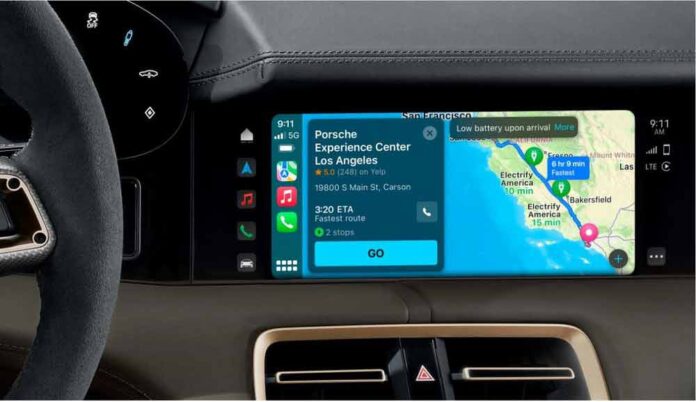
The Porsche Taycan will feature Apple Maps EV-charger routing to enhance the worry-free travel experience of iPhone users. The EV routing capability comes to U.S.-based Taycan models directly within Apple CarPlay®.
This new Apple Maps® EV-charger routing feature provides:
Vehicle state of charge (SOC)
Exact locations of charging stations along the driver’s plotted route, and
Estimated charging times
Credit: Porsche AG
Apple Maps EV-Charger Routing Streamlines Navigation
Porsche Digital, Inc., of Palo Alto, California, gives U.S.-based Taycan owners the ability to navigate and route-plan via Apple Maps within Apple CarPlay. Porsche Digital collaborated with Apple® to make this happen.
Consequently, drivers can remain within the CarPlay ecosystem to plot a direct route. This provides intermediate charging pit stops along the way.
Every Taycan will feature the Porsche Charging Planner (PCP). PCP optimizes designated charging stops in accordance with anticipated state of charge (SOC) on each arrival. PCP also factors in average speed within the parameters of current traffic conditions. Thus this affords Taycan owners more leeway in plotting their routes.
Greater Flexibility in EV Route Planning
“We’ve listened to our customers, and they appreciate flexibility,” states Steffen Haug, Managing Director, Porsche Digital, Inc.
“This integration with a product that they are already familiar with gives more options and confidence in how they use their Taycan, both in day-to-day activities and on longer road trips.”
Apple Maps EV-charger routing furnishes more flexibility via real-time vehicle data to assist drivers with optimal navigation to reach their destinations. This EV routing analyzes such things as elevation changes and other factors along the route. The EV routing uses this info to identify and recommend charging stations between Points A and B.
Apple Maps and My Porsche App Coordination
In this way, if the vehicle’s charge falls too low at any given point traveled, then the driver is provided with a suitable route to the nearest compatible charging station.
U.S.-based Taycan owners will be able to access Apple Maps EV routing through the latest My Porsche app on their iPhones. Owners can simply follow a few easy steps in both the My Porsche app in conjunction with Apple Maps to enable this novel feature.
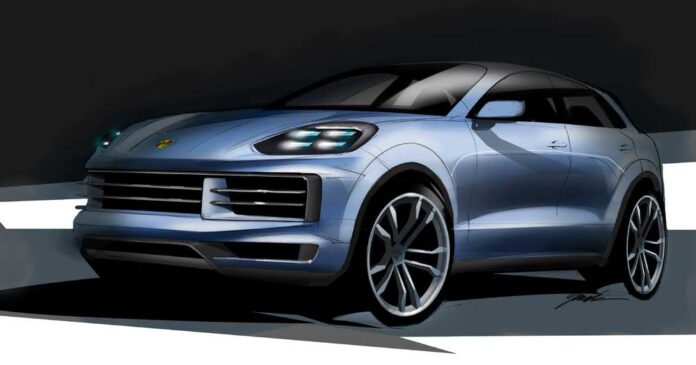
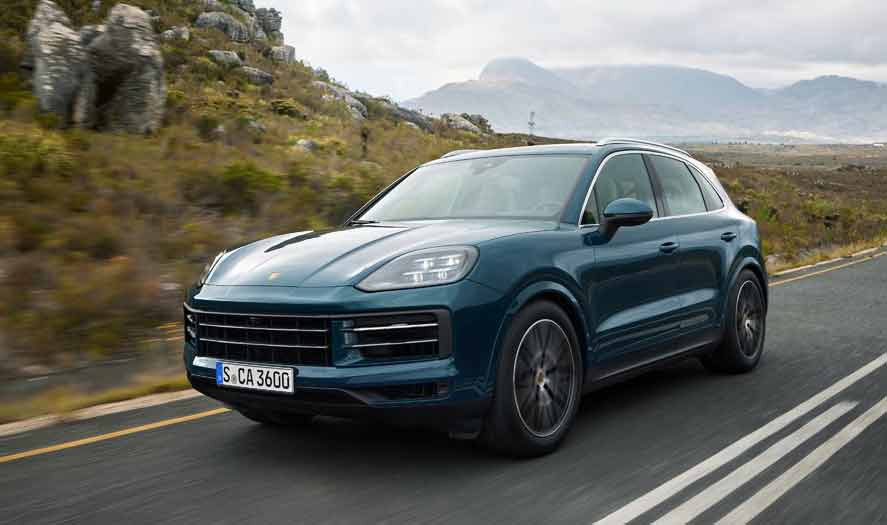
The Porsche Cayenne gets a fresh Stuttgart roll-out in the form of the new 2024 Porsche Cayenne. The 2024 Porsche SUV sports substantial all-new upgrades. This particular Porsche Cayenne is the third-generation luxury Porsche SUV benefiting from a mid-cycle comprehensive update.
Enhancements to the Zuffenhausen company’s popular Porsche Cayenne include upgrades improving performance, comfort, styling, and technology too.
The new Cayenne’s tweaks include: exterior refreshes, engine power boosts and selection (e.g., return of the V8), select interior enhancements, and chassis improvements. You can order the 2024 Cayenne now starting at $79,200 plus destination fees, with deliveries arriving this summer 2023 at dealers across the States.
Credit: Porsche AG
Updates to the 2024 Porsche Cayenne’s Luxurious Interior
The new Porsche Cayenne gets a totally redesigned interior and dashboard layout. New to the 2024 luxury Porsche SUV is the concept of the Porsche Driver Experience, optimizing the driver’s control of crucial functions, as its name implies. This notion was first seen in the Taycan. It entails improvements concerning driver controls placed right on steering wheel or as close as possible to steering wheel.
In addition, other vital driver functions are placed on a stalk to the left of and behind the steering wheel. The gear selector has been moved to the dashboard; this frees up the new center console above the transmission tunnel for a larger A/C and heating climate controller and for a slight increase in storage.
The instrument cluster is also new to the Porsche Cayenne 2024. It consists of a curved, freestanding 12.5-inch digital-analog-combo display screen and variable display options. An optional head-up display is on offer.
The standard PCM 12.3-inch infotainment touchscreen includes the latest Porsche Communication Management software — as well as such native apps as Apple Music and Spotify to optimize connectivity in the Porsche SUV.
Credit: Porsche AG
And then there’s the passenger screen as an option, a 10.9-inch display, which is new for first time to the Cayenne. Originally seen in the Taycan too, it consists of an infotainment system to stream video while on those sought-after road trips. Porsche claims its screen utilizes a special concealing optical layer, making the playing video non-visible to the driver.
Credit: Porsche AG
Sharper Exterior Design for the 2024 Porsche Cayenne
The new 2024 Porsche Cayenne sports a refreshed front end. It includes redesigned fenders, hood and headlights, just above the restyled bumper, which features more functional and striking air intakes. The rear end has been revamped too. It includes three-dimensional taillights, a new rear fascia with a much better integrated license-plate holder.
New colors have been added to expand the Cayenne’s color palette: Arctic Grey, Algarve Blue and Montego Blue Metallic. There is also a fresh, new selection of wheels in 20-, 21- and 22-inch sizes.
Credit: Porsche AG
The 2024 Porsche Cayenne Gets a Beefier Family of Engines and the Return of the V8 — Probably the Last of the Cayenne ICEs
The family of engines for the Porsche Cayenne for 2024 has been beefed up across the board. This is most likely the last family of Cayenne internal-combustion engines, sadly. In ascending order of model trim, these are the latest upgraded, more powerful engines:
Cayenne standard base model 3.0L V6 turbo engine. Credit: Porsche AG
Cayenne — the standard base model
Optimized 3.0-liter V6 single-turbo engine
348 horsepower and 368 lb.-ft. of torque, which is 13 hp and 36 lb.-ft. more than the previous model year
Cayenne S 4.0L V8 twin-turbo engine. Credit: Porsche AG
Cayenne S
Twin-turbo 4.0-liter V8 engine, replacing last year’s 2.9-liter V6 engine
468 horsepower and 442 lb.-ft. of torque, 34 hp and 37 lb.-ft. more than its six-cylinder predecessor
Accelerates both the SUV and the SUV Coupé to 60 mph in up to 4.4 seconds when equipped with the Sport Chrono Package
Top track speed = 169 mph
Cayenne E-Hybrid powertrain. Credit: Porsche AG
Cayenne E-Hybrid
Optimized 3.0-liter V6 single-turbo engine from the base model combined with the new 174-hp electric motor
463 combined horsepower
New high-voltage battery boasting an increased capacity from 17.9 kWh to 25.9 kWh
A new 11 kW on-board AC charger now reduces the charging time at a compatible power source to less than two and a half hours in spite of the enlarged battery capacity
Cayenne Turbo GT, available exclusively as a coupé
Twin-turbo 4.0-liter V8 engine
650 horsepower and 626 lb.-ft. of torque, 19 hp more than last year’s model
Zero to 60 mph in 3.1 seconds
Top track speed = 189 mph
While we’re on the subject of the Cayenne Turbo GT, here are some of its reported standard equipment:
Porsche Dynamic Chassis Control (PDCC)
Porsche Ceramic Composite Brake (PCCB)
Rear-axle steering
Sport Exhaust system with titanium tailpipes
22-inch GT Design wheels fitted with ultra-high-performance tires
Credit: Porsche AG
Chassis Refinements on the 2024 Porsche Cayenne
New-and-improved chassis features further enhance the 2024 Porsche Cayenne. Now coming standard on the new Porsche Cayenne are Porsche’s PASM adaptive dampers. They comprise a new two-valve suspension for compression as well as rebound.
Adaptive air suspension comes optional but is standard equipment on the Turbo GT. Tweaked rear torque-vectoring and rear-axle steering systems appreciably improve road-and-track handling.
Credit: Porsche AG
Concluding Thoughts on the Upgraded 2024 Porsche Cayenne
The Porsche Cayenne 2024 grants all of the aforementioned tweaks, and then some. The Cayenne’s base wheels have been increased from last year’s 19 inches in diameter to 20 inches, for example. This expands the contact patch and thus increases mechanical grip. How bad can that be?
Credit: Porsche AG
Porsche Cayenne Standard Equipment
The Porsche Cayenne models for 2024 come with some of the following expanded standard equipment:
Comfort Access keyless entry
Lane Change Assist
Lane Keep Assist
Matrix Design LED headlights
Porsche Active Suspension Management
Smartphone tray with inductive charging at up to 15 watts
Credit: Porsche AG
Porsche Cayenne Pricing
Pricing for the 2024 Porsche Cayenne models (all include the $1,650 Delivery, Processing and Handling Fee)
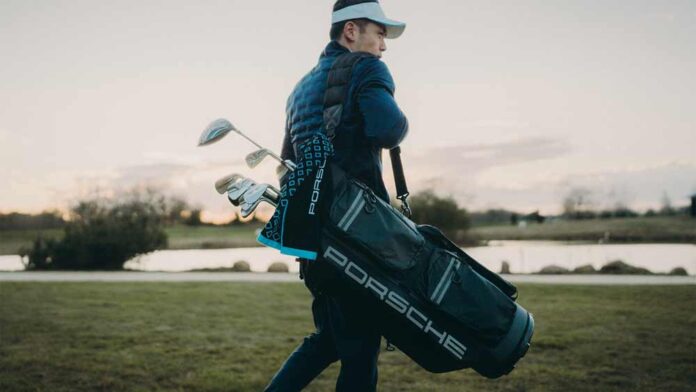
The New Porsche Design Golf Collection could be just the ticket for both avid Porschephile golfers and ardent non-Porschephile golfers alike. Porsche Design’s Golf Collection offers up the basics — albeit the most stylish, sophisticated “basics” for which the PD brand is world-renowned:
The PD Golf Collection presents a golf cart bag and a bag with a stand. Also presented is a golf travel bag in which to stow your golf bag and clubs when traveling to play, say, the most prestigious golf courses round the planet.
Comfortable, balanced and adjustable carrying system
Glove, umbrella and towel holder
4-way divider compartment for your golf clubs
Constructed of 100% water-repellent nylon
Waterproof rain hood, and best of all
“PORSCHE” silicone lettering on the side
Whether you drive a Porsche 911, Boxster, Cayenne, Cayman, Macan or Taycan — or even some other vehicle manufactured outside the city limits of Zuffenhausen — these gems in the Porsche Design Golf Collection are perfect for the golfing enthusiast.
But don’t be selfish. Porsche Design’s golf bags could also serve as perfect golf gifts for men, or golf gifts for women too.
And as they say . . . “but wait, there’s more . . . “
Golf Travel Bag — Sport. Credit: Porsche Design
A Porsche Design Golf Travel Bag to Transport Your Golf Bag and Clubs
The new Porsche Design Golf Collection also smartly includes a golf travel bag in which to stow your golf bag and clubs when globetrotting to play some of the best golf resorts offered internationally.
Water-repellent cover to protect your golf bag and gear
Protective foam shell and padded side walls
Suitable for bags bearing a maximum top diameter of 11 inches
Constructed of 100% tarpaulin/nylon, and, again, best of all
“PORSCHE” silicone lettering on front
Concluding Thoughts on Par (and More)
So what’s not to like about the latest Porsche Design Golf Collection? It introduces a nice choice of awesome golf bags and a “form-as-well-as-functional” golf travel bag.
Again, each gem in the collection can also serve as coveted golf gifts for men, as well as golf gifts for women. The lucky recipients will be forever grateful.
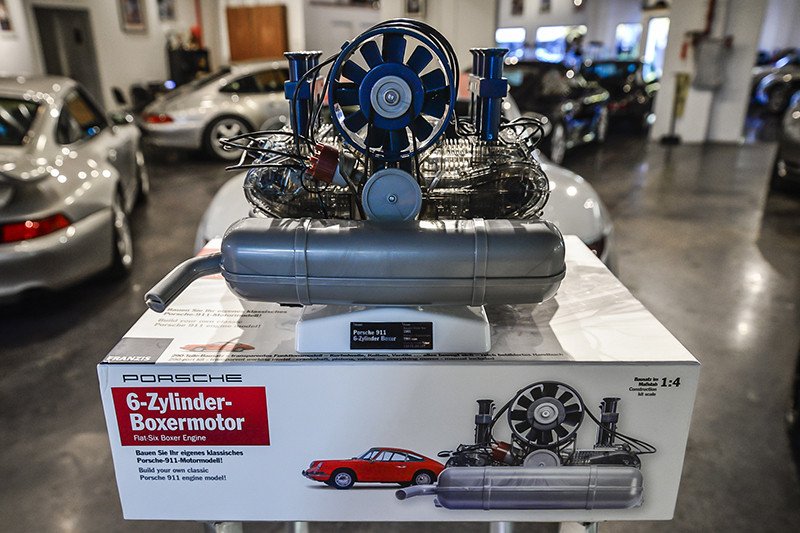
Calling all Porschephiles! Be the first on your block to build your very own Porsche flat-six engine. Franzis’ Porsche Flat-Six Engine Scale Model Kit is now available.
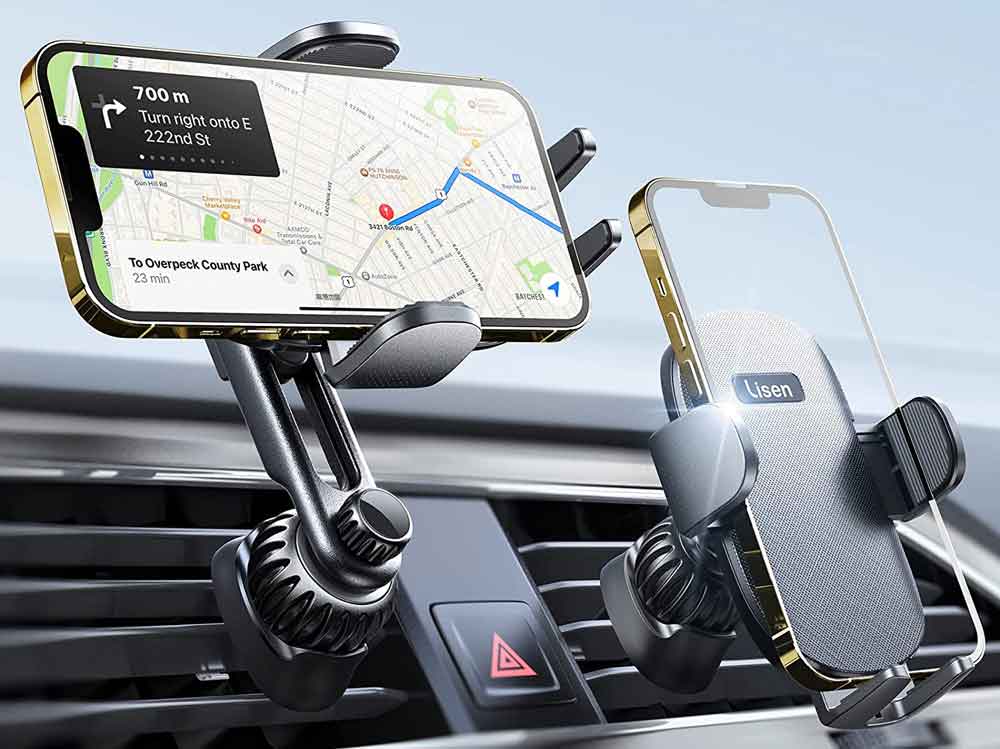
Our StuttgartDNA Car Phone Holder Buying Guide will help you sort through all types, styles and features of car phone holders and car phone mounts. You will be able to make much more intelligent decisions and choices by the time you finish this article.
There is a dizzying array of cell phone holders, mounts and cradles in the marketplace. So you’ve come to the right place. We’ll assist you in zeroing in on phone car mounts most suitable to your own unique needs.
Smartphones have become indispensable in our everyday lives. Our cell phones in effect rule almost every waking moment of our lives — for school, work, pleasure, you name it. They have become virtual appendages — even infiltrating our cars, SUVs and trucks.
We use our smartphones in our vehicles for navigation, information, entertainment and communication.
So how best to mount and use our cell phones as safely as possible on the road? Here we show you some of the best ways to do just that.
A proper car phone holder serves one vital function: allowing you to use your phone with the least distraction possible while on the road — with both hands on the wheel and eyes on the road.
The aim of a good phone mount is to align you field of vision as narrowly as possible — keeping your line of sight on the road within the shortest distance possible to your phone.
Finally, it is imperative to install a phone holder in cars that didn’t come with the option of an integrated navigation system. A suitable car phone mount will aid you in this case with the following tasks:
Making safe phone calls
Calling via your phone’s voice assistant
Getting audible turn-by-turn directions
So we’re here to help you find that ideal car phone holder to suit all of your smartphone vehicle needs. Let’s get started.
As an Amazon Associate, StuttgartDNA may earn a modest commission via links on our site from your secure purchases on Amazon.com — but at absolutely no additional cost to you. Thanks for your support!
Three Basic Car Phone Holder Types
These basic types of cell phone holders for car, SUV or truck involve how the holder attaches inside your car.
A forth, but relatively rare, basic car phone holder type mounts within your car’s CD slot, if your car has one. Chances are, it does not nowadays. See the iOttie Easy One Touch 5 CD Slot Mount example above.
Two Vent-Mount and Dash- or Window-Mount Sub-types
There are two sub-types of attaching mechanisms holding the phone itself to the car phone mounts that follow.
Magnetic- or adhesive-attached mounts — your phone connects to the car phone holder with a magnet; however, the magnet may have to be attached to your phone or phone case with a sticky adhesive substance. See the Scosche MPWDB MagicMount Pro Magnetic Car Phone Holder example above.
Very easy to operate
The magnet itself will probably not harm your smartphone’s innards because today’s phones consist of mostly non-metallic circuitry
Cons:
If magnetic-based, may require attachment of a small metal plate to your case or to the back of your phone
If adhesive-based, may require permanent placement which could damage the surface to which it’s adhered with glue; could also prevent transfer between vehicles
May interfere with wireless charging if it obstructs your phone’s charging coil
EXAMPLE
Tension Arm-Attached Mounted Car Phone Holder
Credit: Amazon
iOttie Easy One Touch 4 Dash & Windshield Car Phone Mount
Tension-arm mounts function in the following manner, in most cases: The extendable right tension arm can be pushed outward wide enough for your phone to fit; then it can be released to snugly secure your phone in the cradle.
However, be aware of the fact that tension-arm-type mounts make it a little more difficult to attach and remove your phone.
Desirable Features
Here are features that you should look for in car phone mounts during your search. Try to round up as many of these features in your phone-holder candidates as you can for the best fit.
Size Versatility
It is important to obtain a phone mount that can accommodate the size of your smartphone. This is especially important if you plan to use your phone with a case. What good will a phone mount do if you have to keep removing your case to fit your phone in the cradle once you get in your vehicle?
Mounting Stability
Keep in mind that your chosen car phone holder should hold your phone quite snugly and securely inside your car. This is especially critical to make sure your phone stays put over any type of rough terrain on which you might be traveling.
Maneuverability
Be sure to seek out phone mount candidates that allow you to easily adjust the phone screen. You should be able to rotate and/or swivel the screen well within your field of vision — yet without obstructing your view of the road ahead.
In other words, your car phone holder should allow for ample vertical and horizontal rotation and about 45 degrees of movement tilting back and forth or to the sides.
Ease of Use
Look for phone holders that allow you to attach, remove and adjust your phone with ease — especially with one free hand. This could make all the difference in the world in helping you keep your eyes on the road, and at least one hand on the wheel at all times.
Factors to Consider
Versatility in moving from car to car
Do you wish to use your car phone mount in only one vehicle? Or do you need to move your car phone holder from on vehicle to another?
Strength of magnets
If you are leaning toward magnetic attachments for your phone, will the magnets be strong enough to keep your smartphone very secure in its place?
Location of where to mount your car phone
Have you thought about where, exactly, you would like to locate your phone mount in your car? If so, are you considering how it will be best attached in that chosen location?
Adhesion to textured vs. smooth surfaces
If you are planning to obtain a car phone mount with a suction cup to attach it to your windshield or dashboard, will its suction be strong enough to hold fast on the targeted surface? And will the suction cup adhere firmly to textured surfaces, if that is the case in your vehicle?
Reusability of adhesive pad
Are you leaning toward a car phone mount that requires an adhesive material for attachment? If so, consider the difficulty factor in being able to remove the mount in the future. Also, think about the ability to reuse it. Or will you need a new car phone holder for reattachment in another vehicle or in a new position?
Attaching your car phone mount to your windshield
Beware! Do your state and local jurisdictions allow you to mount, or prohibit you from mounting, your phone holder to your windshield? Be sure to check you state and local ordinances first before purchasing.
Maneuverability of your car phone holder
Will you need to adjust the screen to view from different angles? Or is one relatively rigid position satisfactory?
Stability of Phone Mount
Is your chosen phone mount sturdy and stable enough to hold your phone firmly in place? Or does your selected car phone holder compel you to take your hands off the wheel to constantly readjust your phone’s position, and/or to take your eyes off the road? It is critical for your safety that your phone and phone mount do not distract you.
Conclusion
Be mindful of all the features that go into making a very safe car phone mount to use. Do your best to seek out as many of those features as possible. Then search for the best phone mount that suits your unique needs the best.
Hopefully, you are now forearmed and forewarned to go out there and shop for that car phone holder that you really want and really need.
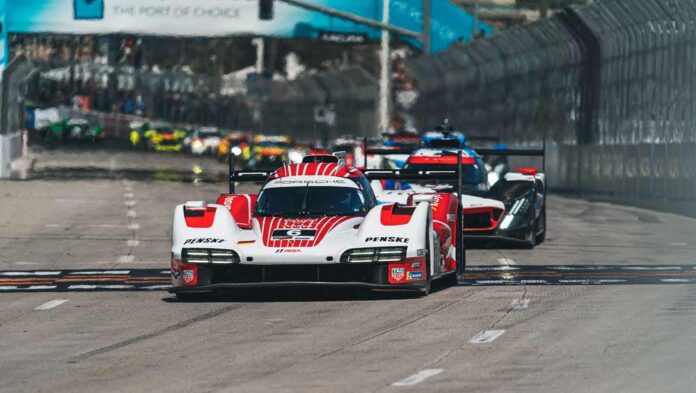
The Porsche Penske Motorsport 963 wins IMSA Long Beach, driven by Nick Tandy (UK) and Mathieu Jaminet (F). The No. 6 car’s GTP class win marks the Porsche 963 hybrid prototype’s inaugural victory during Round 3 of the IMSA WeatherTech SportsCar Championship.
Team members Matt Campbell (AUS) and Felipe Nasr (BR) in the 963 No. 7 car also rose to the podium. Both drivers took third place in the 100-minute sprint through the SoCal streets of balmy, sunny Long Beach, just south of Los Angeles.
Porsche claimed another podium in the GTD-Pro class. Klaus Bachler (A) and Patrick Pilet (F) muscled their No. 9 Porsche 911 GT3 R across the finish line in third place for Pfaff Motorsports from Canada.
Made in acclaimed Flacht, the two Porsche Penske Motorsport 963 hybrid prototypes displayed vast improvements over their performances in the previous 24 Hours of Daytona (Round 1) and 12 Hours of Sebring (Round 2) of the 2023 IMSA WeatherTech SportsCar Championship.
The Porsche Penske Motorsport No. 7 car of Campbell and Nasr qualified in sixth place. The Porsche Penske Motorsport No. 6 car of Tandy and Jaminet started the race in eighth place on Long Beach’s narrow street circuit along the sun-drenched Pacific coast.
Credit: Porsche AG
Critical Keys to the Porsche 963 Prototypes Staying in the Hunt
Good fortune began flowing Porsche’s way from the get-go: At barely 9 seconds in, Sebastien Bourdais (F) in the No. 1 Cadillac unfortunately spun and crashed into the wall; this mishap paved the way for the No. 6 and No. 7 Porsche GTP cars to advance to second and fifth place, respectively.
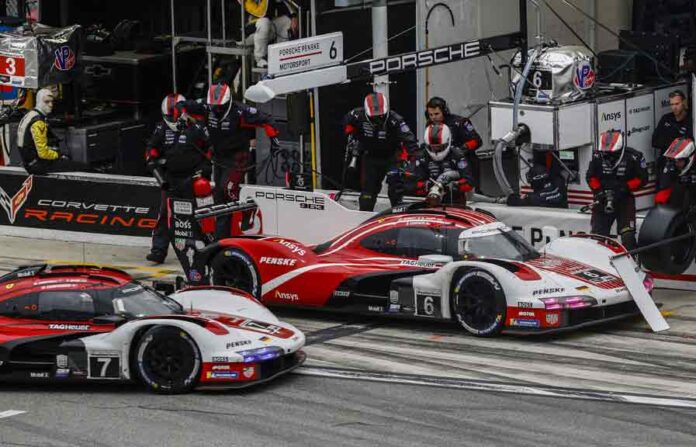
Another beneficial turning point, one of the strategic variety, occurred during the first scheduled service and driver change. After scrapping fiercely to hang on to their positions in the field, Nick Tandy and Felipe Nasr, the first-stint drivers, boxed the two Porsche 963 in the middle of the race.
Once the two sister cars were in the pits, the Porsche Penske Motorsport works team executed a bold calculated ploy: Instead of changing tires at all four corners like the rest of the GTP field, the Porsche works team double-stinted their tires on both cars — testament to Porsche’s trust in the race-tested durability of Michelin tires.
Sure enough, those precious seconds saved in the pits catapulted the two Porsche hybrid prototypes to the front of the field.
Credit: Porsche AG
Porsche Penske’s Turning of the Tide on the Long Beach Shores
But then in the race’s latter stages, Campbell in his No. 7 Porsche was busier than a one-legged man in a butt-kickin’ contest. The Australian came under relentless assault from his GTP-class competitors. Yet Campbell was ruthless in countering this onslaught of attempted overtakes.
Then it looked like Campbell’s pluck as well as his luck were finally running out. Not only did his No. 7 Porsche sustain rear downforce damage in a non-lethal paint-trading collision, but his tires also deteriorated dramatically during the last ten laps.
Meanwhile, Jaminet in his No. 6 Porsche was way out in front in clean air. He seemed impossible to catch. But seasoned Ricky Tailor (USA) in his No. 10 Acura didn’t quite see it that way. In fact, the Acura kept relentlessly closing the gap, lap after lap.
Credit: Porsche AG
Porsche Penske’s Final GTP Hurdle to Long Beach’s Victory Lane
Then it happened. Taylor finally caught up to the rear of Jaminet’s Porsche. Taylor went in for the kill, just about passing Jaminet — but misjudged the braking zone in this do-or-die effort. The dare-devil move for all the marbles caused him to crash his Acura into tire barriers that, ironically, were draped in end-to-end-to-end “Acura” banners.
Jaminet would later recall, “When the Acura appeared in my rear-view mirror towards the end, I knew he was going to attack – after all, I was on the back foot with significantly older tires. He tried to out-brake me in the first corner.
“I immediately realized he wasn’t going to make the corner and I took evasive action while he landed in the tire barriers. That was some real nail-biting stuff at the end of the race.”
Prior to that accident, though, Campbell had lost two positions as a result of the previous collision and his shredded tires. There were nine minutes left on the clock.
But then Ricky Taylor’s sudden crash enabled Campbell to recapture his third-place position. Ultimately, because of that Acura wild encounter with the tire barriers, the race came to a docile but utterly satisfying end under a full-course yellow behind the safety car.
Thus the two Porsche Penske 963 hybrid prototypes triumphantly podiumed in first and third place, respectively.
Credit: Porsche AG
Porsche Penske Motorsport Savors Its Historic Inaugural GTP Win
“What an exciting and fantastic race,” enthused a delighted Thomas Laudenbach, Vice President, Porsche Motorsport. “It was a spectacle from the first to the last lap. Our team chose an optimal strategy and did a perfect job with the pit stops.
“Our drivers gave their utmost and drove flawlessly without exception despite coming under enormous pressure. This performance was deservedly rewarded with our first victory.”
Jonathan Diuguid, Managing Director, Porsche Penske Motorsport, also asserted in elation, “This day will go down in the history of our team. The first victory with the Porsche 963 is incredibly important to us. We put in so much energy and work to be able to celebrate such a success. We owe this triumph to every single person in the team.”
This Round 3 Long Beach victory garners the lead for Tandy and Jaminet in the drivers’ championship. The win also places Porsche in third-place ranking in the GTP-class manufacturer’s classification.
Credit: Porsche AG
Porsche Also Podiums in the GTD-Pro Class
Behind the wheel of the new Porsche 911 GT3 R No. 9 car, Patrick Pilet (F) and Klaus Bachler (A) muscled their way up to the podium’s third-place step for Pfaff Motorsports. The GTD-Pro class race was just as thrilling as the GTP class race as a result of Pilet and Bachler’s near-perfect drives and the Pfaff team’s solid support.
In the GTD class, identical Porsche 911 GT3 R models managed by Wright Motorsports and Kelly-Moss by Riley completed the race uneventfully in tenth, twelfth and thirteenth places.
Credit: Porsche AG
What’s Next for the Porsche Penske Motorsport Team?
No rest for the weary: On the following day, Sunday, the Porsche Penske Motorsport team contested Round 2 of the FIA World Endurance Championship WEC at the six-hour race in Portimão, Portugal. Two of the factory squad’s Porsche 963 competed in the Hypercar class.
Still hanging out in balmy California, Round 4 of the IMSA WeatherTech SportsCar Championship plays out on legendary Laguna Seca Raceway, spiraling down the notorious Corkscrew, on May 14, 2023.
The two Penske Porsche 963 Hybrid Prototypes did not perform quite as planned in their IMSA debut during last week’s Rolex 24 Hours of Daytona. The Porsche Penske Motorsport factory team prepared long and hard in the pre-season. But a spin-out and mechanical issues, respectively, dropped both the No. 6 and No. 7 Hybrid Prototypes far down the field during their maiden voyage at the 61st running of the venerable Daytona 24h endurance classic.
Yet, despite lengthy repairs dropping both 963 prototypes back down in the field, the two cars managed to chalk up critical points in the IMSA WeatherTech SportsCar Championship.
The No. 7 Penske Porsche 963 Hybrid Prototype of Matt Campbell (Australia), Felipe Nasr (Brazil) and Michael Christensen (Denmark). Credit: Porsche AG
Gremlins Wreaked Their Usual Enduro Havoc on the 963 No. 7 Prototype
But then, at approximately 7:00 pm local time on Saturday, it happened: Just over five hours in, the hybrid system’s telemetry went haywire. The pit team urged the No. 7 car to box for repairs behind the wall in the garage. The mechanics feverishly replaced the high-voltage battery pack that went kaput.
After all of that hard work, though, the No. 7 car of Matt Campbell (Australia), Felipe Nasr (Brazil) and Michael Christensen (Denmark) then sustained further near-catastrophic damage to its cooling system. This forced the prototype to head back into the Porsche Penske Motorsport garage for more time-consuming, nail-biting repairs.
The No. 6 Penske Porsche 963 Hybrid Prototype of Nick Tandy (UK), Mathieu Jaminet (France) and Dane Cameron (USA). Credit: Porsche AG
The 963 No. 6 Prototype Ultimately Suffered a Dreaded DNF
The No. 6 Hybrid of Nick Tandy (UK), Mathieu Jaminet (France) and Dane Cameron (USA) got off to a very promising start. Beginning the race from P9, Nick Tandy, factory team returnee and 2015 outright Le Mans winner in the Porsche 919 Hybrid, zoomed full steam ahead to run with the lead pack after night fell. He and his two teammates even led the field from time to time.
Then the No. 6 Prototype suffered a major setback when Tandy spun out. This freak mishap cost Tandy and the boys big-time, as the No. 6 car lost three whole laps. Nevertheless, the Porsche 963 fought its way back within striking distance of the top dogs at the front.
Tandy’s valiant efforts turned out to be all in vain, however. His car began experiencing braking issues emanating from the “degenerating” regenerative braking system mounted on the rear axle. He began careening deeper and deeper into the track’s braking zones, as the Prototype’s brakes continued to progressively fade.
Adding insult to injury, the car subsequently began spewing billows of white smoke. Thus, not unlike doomed Sisyphus and his tumbling boulder rolling down the hill, the No. 6 Porsche 963 started falling further and further back down the field: The gremlins struck for the final time — catastrophic gearbox failure.
So, after 700 laps, just 83 laps shy of reaching the checkers, the No. 6 Hybrid Prototype was forced to retire — Porsche’s first DNF of the young Championship season.
The No. 7 Prototype’s “Pyrrhic Victory”
The No. 7 car of Campbell, Nasr and Cameron suffered a Pyrrhic victory insofar as not scoring a podium, but exhibiting promise to be competitive in future IMSA Championship rounds. The Prototype took the GTP-class flag in seventh place overall in the Daytona 24h classic, a disheartening 34 laps down.
Consequently, it wasn’t in the cards this year for Porsche to turn this outing into the nineteenth win to increase Porsche’s previous 18 overall Porsche wins at the 24 Hours of Daytona — but there is always the next race for the first win of the year at the 12 Hours of Sebring on Saturday, March 18, 2023.
GTP Class Race Results:
1. Blomqvist/Braun/Castroneves/Pagenaud (UK/USA/BR/F), Acura ARX-06 No. 60, 783 laps
2. Taylor/Albuquerque/Deletraz/Hartley (USA/P/CH/NZ), Acura ARX-06 No. 10, 783 laps
3. Bourdais/van der Zande/Dixon (F/NL/NZ), Cadillac V-LMDh No. 01, 783 laps
7. Campbell/Nasr/Christensen (AUS/BR/DK), Porsche 963 No. 7, 749 laps
DNF — Tandy/Jaminet/Cameron (UK/F/USA), Porsche 963 No. 6, 700 laps
PORSCHE TENACIOUSLY WON 18 OVERALL WINS at the 24 Hours of Daytona, as of this writing. However, Porsche will again clash with its competitors for that coveted No. 19 win at this weekend’s 2023 running of the 24-hour immortal race classic.
As usual, the endurance race runs at Florida’s venerable Daytona International Speedway in Florida, which first opened in 1959.
Credit: Porsche AG
So How Many Total Porsche Wins during the 24 Hours of Daytona?
Porsche has doggedly fought for and garnered 18 overall wins to date as a constructor at the Daytona 24. In addition, Porsche has won four wins as an engine partner. If that isn’t enough, the automobile manufacturer from Stuttgart boasts an additional 80 class wins so far.
It’s interesting to note that, by comparison, Porsche’s 18 Daytona-24 overall victories are just one shy of its 19 overall wins at the 24 Hours of Le Mans. Not bad, not bad at all.
Rennsport Reunion V: Porsche Gulf-liveried 917s and other Porsche race cars winding down Laguna Seca’s famed Corkscrew. Credit: Porsche AG
What Cars Won Those 18 Overall Daytona Victories? And Who Were the Drivers Behind the Wheel?
See how many answers to these questions you can recall. Test your own knowledge. Then compare your answers against the table below. But don’t cheat…!
Simply click on a driver’s name above to learn more about him. Also click on any Porsche listed above to learn more about each winning race car.
At the 2023 24 Hours of Daytona seen here are the Porsche 963, Porsche Penske Motorsport (#7), of Felipe Nasr (BR), Matt Campbell (AUS), Michael Christensen (DK); and the Porsche Penske Motorsport (#6), of Nick Tandy (UK), Mathieu Jaminet (F), Dane Cameron (USA). Credit: Porsche AG
As you can see in the table above, Porsche hasn’t garnered an overall win since 2003 — exactly a long 20 years ago. Let’s hope this weekend will end that two-decade drought, with Porsche earning its 19th win – hopefully courtesy of Team Penske Motorsport. Fingers crossed . . .
ON THE HEELS OF PORSCHE’S ANNOUNCEMENTS, touting a future 911 Hybrid and the firing up of its maiden Chilean eFuel plant comes news that Porsche is also flirting with hydrogen energy for its internal-combustion engines (ICE).
Furthermore, the luxury automaker nestled in Stuttgart-Zuffenhausen conceived an actual hydrogen-engine prototype. More important, though, said prototype is said to outperform a 4.4-liter V8 gasoline engine.
The H2 engine spawns at least two advantages right off the bat:
Reducing fuel consumption
Sustaining negligible emissions on par with ambient air
But not so fast. Originally conceived in mid-2022, the H2 engine is a digitally hatched construct. No matter, though. It’s certainly an encouraging albeit incremental leap in the right direction, hopefully out-rivaling electromobility someday, as is the prevailing natural order of the day at present.
The conventional internal combustion engine required several modifications and alterations, such as increasing compression ratios and fashioning a heavy-breathing turbocharging system.
Courtesy of Porsche Engineering, these tweaks, among another one or two perhaps, are what led to achieving clean H2 combustion.
In the final analysis, the hydrogen engine managed a respectable 440kW max output and a top speed of 261km/h, thus edging out the V8 by a hair.
We’ll endeavor to keep you posted on any additional future breakthroughs.
Porsche Engineers Shed New High-Resolution Light
PORSCHE IS DEVELOPING new high-resolution LED main headlights with HD matrix beams. These innovative headlight assemblies enable high-resolution light distribution that is twice as bright as existing headlight systems.
The clever crux of this new high-resolution HD matrix technology resides in an ingenious next-generation LED chip that combines over 16,000 individually controllable micro-LEDs on a surface area the size of a thumbnail.
Each chip provides a high-resolution light distribution that is up to twice as bright on a surface four times larger than previous superior systems. Porsche submitted over 25 patents together make this innovative technology a reality.
After several less-than-ideal passes, Porsche chose to go with the new and efficient HD matrix LED technology with 16,384 pixels per module, rather than the maximum resolution that is technically feasible.
According to Porsche, this leap in performance in light technology is attributed to this efficient generation of light — and the combination of the two HD matrix modules with two bi-functional modules. Only light that is actually necessary is generated. Thus this novel technology is dubbed “active matrix light generation.”
Porsche optics engineers have ingeniously developed six state-of-the-art technological functions that combine into a cohesive innovative whole that is greater than the sum of its “hexagonal” parts:
High beam with auxiliary high beam (high-performance high beam)
Non-dazzling high beam with new function
Lane illumination
Construction and narrow-lane light
Adaptive motorway high beam, and
Animation as greeting and send-off
For greater edification on this state-of-the-art Porsche headlight technology in general and the six aforementioned functions, click here for Porsche’s further elaboration.
Porsche Reports a Very Modest 2022 Global Sales Increase
PORSCHE POSTS A MODEST INCREASE in 2022’s annual worldwide sales. The Stuttgart-based German automobile manufacturer reports 309,884 total worldwide deliveries, a slight 3 percent increase over 2021’s global sales of 301,915 deliveries.
Porsche attributes this lackluster 2022 increase to “several global crises.”
Porsche’s SUVs customarily led the charge. Itemized model sales break down as follows (in descending order):
Cayenne — 95,604 units (delta unspecified)
Macan — 86,724 units (delta unspecified)
911 — 40,410 units (+5 percent)
Panamera — 34,142 units (+13 percent)
Taycan — 34,801 units (-16 percent)
718 Boxster and 718 Cayman — 18,203 units (delta unspecified)
Here are the latest Porsche News Roundupdetails for Sunday, January 8, 2023: “Very sporty” future 911 Hybrid | Porsche eFuels plant | Taycan retaining-ring recall
“Very sporty” future 911 Hybrid foretold by Porsche Chief Oliver Blume
PORSCHE SEEMS TO BE ALL-IN on the electromobility arms race. But an all-electric Porsche 911? Are you serious?! Sacrilege. That’s 100 times worse than picante sauce from New York City. Say it ain’t so, Joe!
Well, our name isn’t Joe, but we’re here to tell you that it ain’t so…at least not yet.
But what is so is Porsche AG’s greenlighting of a “very sporty” future 911 Hybrid. And so intimates Porsche Chief Oliver Blume during an interview with Car Magazine recently. Sign of the times. Even Porsche can’t help but go with the flow (read: impetuous torrent) headlong toward electrifying personal mobility. (Got hydrogen? Anyone…?)
How is Porsche going to power its “very sporty” future 911 Hybrid?
Endeavoring to navigate this imperiled road paved with good intentions, Porsche has acquiesced in developing “a very sporty hybridization to the 911.” Thank goodness, at least, that Porsche plans to employ self-charging hybridization evolved from the original technology found in its Le Mans-winning 919 Hybrid race car.
This is in stark contrast to pursuing the bloated PHEV (plug-in hybrid electric vehicle) mode of electrification, which is the prevailing grossly overweight propulsion approach currently.
Porsche is on pace to garner annual sales of 80 percent consisting of its EVs and hybrids by the end of this decade. The slated 911 hybrid slots right in to this strategic trajectory.
Is an all-electric Porsche 911 possible?
Oh, and about that all-electric Porsche 911 we opened with, Porsche, as such, maintains that an electric 911 iteration won’t emerge on the scene until the early 2030s. In fact, during the aforementioned Car Magazine confab, Mr. Blume reassured, “Talking about the 911, it will be the model which we will drive as long as we can with a combustion engine.”
Yesssss. There is an ICS god . . .
Porsche eFuels plant opens in Chile, South America
PORSCHE’S FIRST eFUELS PLANT was officially opened on December 20, 2022. Porsche AG key board members oversaw the ribbon-cutting of its eFuels “Haru Oni” pilot plant in Punta Arenas, Chile, South America.
Is Porsche partnering with any other companies to produce its eFuel?
Specifically, Porsche and its international partners are collaborating with Highly Innovative Fuels (HIF), the Chilean operating company in this unprecedented monumental endeavor — the industrial production to create unheard-of carbon-neutral synthetic combustion fuels.
How is Porsche creating its eFuel?
Instead of using corn, coal, or natural gas to synthesize a fuel, this latest iteration involves 21st Century “alchemy.” Porsche’s process consists of a concoction of carbon dioxide and water to create — via wind energy — a nearly CO2-neutral synthetic fuel to power internal combustion engines (ICE).
Is Porsche concentrating on eFuel or electric cars, or both?
Porsche’s strategy is committing to blazing a “double-e path” of energy: producing both EV “electromobility” and eFuels as complementary technologies. The goal of the latter innovation, naturally, is to mass-produce its eFuel to dramatically reduce CO2 emissions in tandem with e-mobility.
Porsche, of course, is not alone in this groundbreaking endeavor. Other companies and entities, such as Porsche parent Volkswagen, Lamborghini and Aston Martin, are helming their own efforts to produce synthetic eFuels.
Porsche issues Taycan retaining-ring recall
PORSCHE RECALLS select Taycan vehicles. The culprit: loose retaining rings on the front pneumatic spring struts. More specifically, the root cause is a notch atop part of the air suspension strut.
What is the cause of the Taycan retaining-ring recall?
The loose retaining-ring recall involves the following: The faulty notch may trigger the retaining ring to dislodge and come loose. The result: Sudden loss of air — causing a dislodged strut. Besides feeling or perhaps not feeling the jolt caused by this dislocation, the telltale sign could be illumination of a warning message in the digital instrument display, alerting the driver to an air-suspension malfunction.
What Taycan models are affected by the retaining-ring recall?
The Porsche recall entails 28 potential Taycans. The vehicles affected involve build dates ranging from July 27th, 2021, to November 12th, 2021. The recall zeroes in on the 2021 model year Taycans, involving the Taycan, Taycan 4S, Taycan Turbo S, Taycan 4 Cross Turismo, and Taycan 4S Cross Turismo.
What is Porsche doing to address the Taycan retaining-ring recall?
Porsche received notification of the issue in November 2022, after rising reports of dislodged struts.
Porsche alerted U.S. dealerships of the recall on December 22, 2022. Affected Taycan owners and lessees will be notified of the retaining-ring recall by first-class Porsche-branded mail on February 10, 2023.